
close
Choose Your Site
Global
Social Media


Views: 0 Author: Site Editor Publish Time: 2026-08-26 Origin: Site


Relying on standard fittings for non-standard process piping carries hidden dangers. You might face premature wear, recurring leaks, and unplanned downtime. Off-the-shelf components fit standard commercial applications perfectly. However, industrial chemical handling introduces complex variables. Aggressive media, spatial constraints, and extreme thermal cycling quickly overwhelm standard catalogs. Standard geometries simply cannot accommodate every proprietary machinery layout. Deciding to invest in specialized parts requires careful financial and operational evaluation. You must identify the tipping point where customized safety and reliability outweigh the initial convenience of standard parts. We will explore how exact engineering protects your high-stakes systems from catastrophic failures. You will learn the specific scenarios demanding tailored designs. We will outline the implementation risks you need to manage effectively. Finally, you will discover how to select the right manufacturing partner for your unique needs. This guide provides actionable steps to upgrade your fluid-handling infrastructure confidently.
We first need to define the baseline of fluid control. Off-the-shelf connectors provide undeniable benefits for basic utilities. They offer mass availability and lower unit costs. Standard geometries ensure they fit widely used pipes and hoses seamlessly. Facilities use them daily for water lines, low-pressure air systems, and benign fluid transfers. They are practical, easy to source, and cheap to replace.
However, process environments expose a massive gap in standard capabilities. Standard fittings routinely fail under harsh conditions. They often lack adequate sealing mechanisms for highly volatile chemicals. Incompatible polymer or alloy blends degrade rapidly when exposed to aggressive solvents. A standard PVC fitting might handle water at room temperature perfectly. Introduce hot alkaline solutions, and it will embrittle and crack within weeks.
We must evaluate the financial framework surrounding these components. You should compare the unit cost of a standard part against the catastrophic failure cost. A standard fitting saves you a few dollars upfront. A system failure costs thousands in hazardous cleanup, regulatory fines, and halted production. A custom chemical pipe connector serves as an insurance policy. It protects high-stakes process systems. You are not just buying a premium component. You are investing in uninterrupted operational safety.
| Attribute | Standard Components | Custom Engineered Connectors |
|---|---|---|
| Material Selection | Limited to common alloys and plastics (304 SS, basic PVC) | Exact matching (PTFE, Hastelloy, Monel) to chemical media |
| Dimensional Tolerance | Standard industry deviation allowances | Micro-level precision for proprietary fits |
| Upfront Investment | Low (mass-produced) | High (tooling and engineering required) |
| Failure Risk in Harsh Media | High (leads to frequent replacements) | Minimal (designed specifically for the environment) |
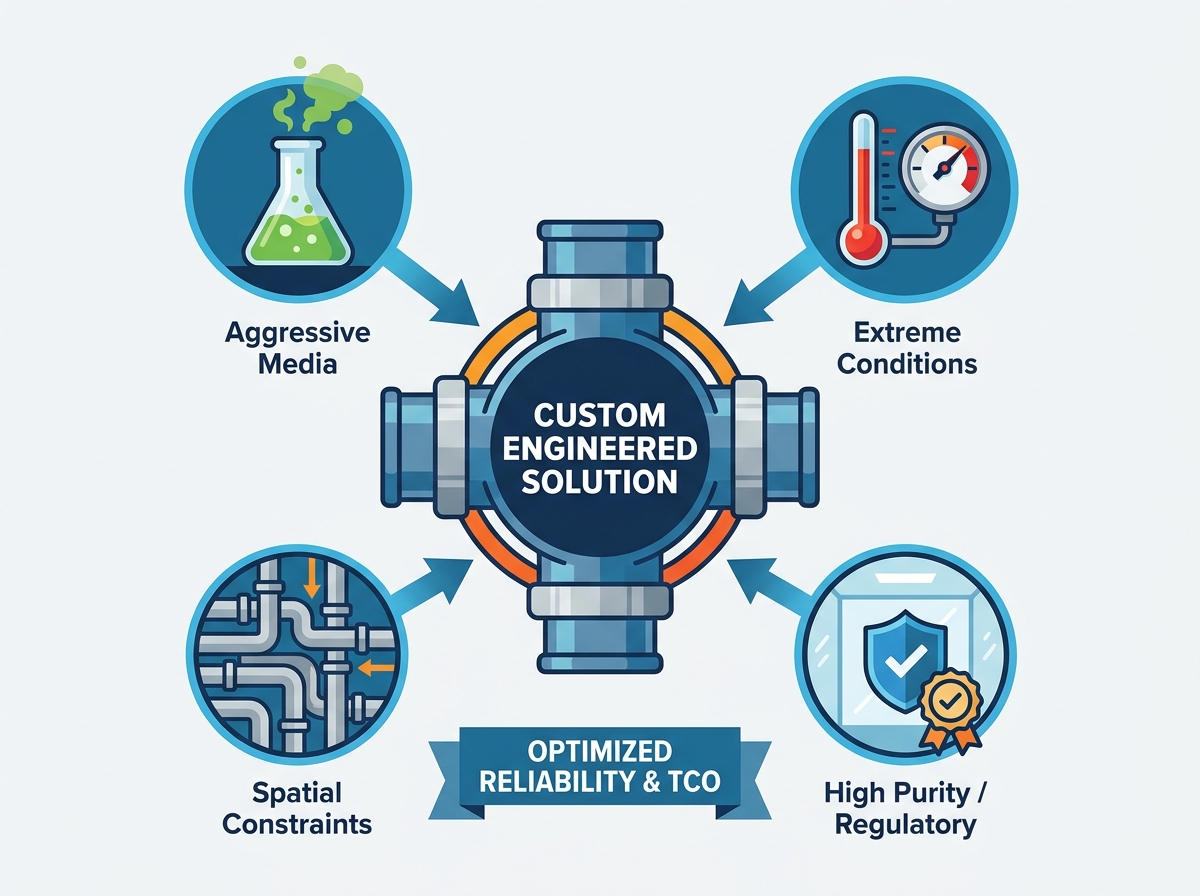
Plant engineers often push standard components beyond their intended limits. This creates unnecessary hazards. You must recognize when a standardized approach no longer serves your facility. The following four scenarios highlight when custom engineering becomes mandatory.
Standard PVC, CPVC, or basic stainless steel degrade quickly under specific chemical loads. Mixed-acid or high-alkaline conditions strip away protective oxide layers on standard metals. They break down the molecular bonds in basic plastics. Customization allows for exact material matching. You can specify PTFE-lined interiors, Hastelloy, or Monel bodies based on exact chemical concentration and temperature. This prevents localized corrosion and extends the lifecycle of your pipeline.
Standard fittings often fail under rapid temperature changes. We call this thermal shock. Standardized wall thicknesses expand and contract unevenly during sudden temperature swings. This causes stress fractures. Defining custom chemical pipe connector specifications allows engineers to dictate critical dimensions. They can specify reinforced wall thickness, exact thread tolerances, and specialized O-ring grooves. These targeted adjustments ensure the joint survives extreme environments without leaking.
Legacy systems or proprietary skids often lack standard threading. They usually offer very tight spatial clearance. Engineers frequently solve this by "daisy-chaining" multiple standard adapters together. This practice introduces multiple potential leak points into the system. A custom chemical pipe connector eliminates this risky workaround. It bridges non-standard ports directly in one solid piece. This simplifies the layout and drastically reduces leak probabilities.
Industries like pharmaceuticals or semiconductor manufacturing require flawless hygiene. They demand ultra-high purity (UHP) standards. Zero-dead-leg designs prevent fluid pooling inside the pipe joint. Standard fittings contain microscopic crevices. These trap residues and invite bacterial growth. Custom sanitary designs ensure complete flushability. They prevent cross-contamination and help facilities pass strict regulatory audits.
Transitioning from catalog parts to engineered solutions involves strategic planning. You cannot treat a custom process piping chemical pipe connector like a routine consumable. You must navigate specific implementation risks to ensure a successful rollout.
The Prototyping Phase demands patience. Do not rush straight to mass production. Detail the necessity of 3D modeling and finite element analysis (FEA). FEA simulates how the component behaves under high pressure and thermal stress. It identifies weak points before any metal is cut. You must also conduct physical prototype testing for chemical compatibility. Soaking a prototype in the actual process media verifies your material selection.
Supply Chain Realities shift dramatically with custom parts. Custom engineering means longer lead times. You cannot order these parts for next-day delivery. Discuss how to mitigate this delay by managing minimum order quantities (MOQs). Establish safety stock agreements with the manufacturer. A good partner will warehouse a reserve batch for you. This guarantees you have immediate replacements during maintenance cycles.
Certification and Traceability require strict administrative oversight. A custom part must still meet or exceed industry safety standards like ASME or ASTM. Ensure the design process includes generating necessary compliance documentation. You must receive Mill Test Reports (MTRs) to verify metal composition. Request hydrostatic or pneumatic pressure test certificates. These documents prove the part can safely handle your specified load.
Choosing the right manufacturing partner determines the success of your custom integration. A poorly equipped shop will deliver parts that look correct but fail under pressure. Avoid these critical errors when evaluating a chemical pipe connector supplier.
You need a structured approach to move from concept to manufacturing. Start by collecting concrete data from your facility floor. Vague requests lead to poor engineering outcomes.
Audit Current Failures carefully. Document exactly how and where standard connectors are currently failing. Look for stripped threads caused by vibration. Identify pitting or corrosion at the weld seams. Photograph the damaged seals. This forensic evidence tells the engineers exactly which weaknesses to engineer out of the new design.
Draft the Specification Sheet with absolute precision. Compile your normal and peak operating temperatures. Note your maximum system pressures, including surge spikes. List the exact chemical media, detailing concentrations and pH levels. Include the required flow rates and any spatial constraints. The more data you provide, the better the final product.
Engage for a Feasibility Study next. Reach out to vetted manufacturers to review your specs. Request a manufacturability and cost analysis. A strong engineering team will point out ways to optimize your design for faster CNC machining. They will help you balance ideal material properties against budget realities.
Standard fittings serve a valuable purpose for standard utilities. However, critical chemical processing requires exact engineering. Relying on catalog parts for volatile media invites unnecessary hazards and unpredictable downtime. You must recognize when your system demands a tailored solution.
Customization shifts your procurement from a reactive replacement cycle to a proactive, reliability-centered strategy. It eliminates the fragile daisy-chaining of adapters. It ensures your materials perfectly match your aggressive solvents. It provides the exact dimensions required for your proprietary equipment.
Stop compromising your process safety with inadequate off-the-shelf components. Document your specific failure points and operating parameters today. Prompt your engineering team to download a specification template or contact a dedicated custom connector manufacturer for a comprehensive design consultation.
A: It varies from 4 to 12 weeks depending on material availability (especially exotic alloys), complexity of the mold/machining, and required testing protocols.
A: Upfront unit costs are higher due to engineering and tooling, but the extended lifecycle and elimination of secondary adapters typically result in lower long-term maintenance costs.
A: Yes. Experienced OEMs can reverse-engineer existing connections to integrate seamlessly with proprietary equipment, provided there are no direct patent infringements.
A: Buyers must provide the chemical medium (concentration), operating pressure/temperature ranges, desired connection types (threaded, flanged, welded), and spatial dimensions or CAD models.


