
close
Choose Your Site
Global
Social Media


Views: 0 Author: Site Editor Publish Time: 2026-08-26 Origin: Site


Procuring highly specialized industrial components rarely happens overnight. Custom PVDF (Polyvinylidene fluoride) components require significant upfront investment. This financial hurdle stems directly from the high cost of raw fluoropolymers and specialized manufacturing requirements. You need an airtight procurement strategy before dedicating your budget to a new production run.
Procurement teams and lead engineers demand predictable timelines. They also need exact volume requirements before committing to a custom tooling or machining project. Unfortunately, navigating supplier minimums and production schedules often feels like a frustrating guessing game. Miscalculating these hidden variables can easily stall a critical pipeline system installation.
This guide completely breaks down the hidden variables dictating minimum order quantities (MOQ) and production lead times. We will help you evaluate complex supplier quotes with absolute confidence. Ultimately, you will learn how to strategically optimize your purchasing cycles for demanding high-purity or highly corrosive application environments.
The chosen production method fundamentally alters your MOQ and lead time baseline. You cannot plan a successful purchasing strategy without understanding how your manufacturer intends to create the part. Engineers typically choose between two primary methods for fluoropolymer shaping. Each path offers vastly different commercial realities.
Manufacturers rely heavily on computer numerical control (CNC) machining for initial product phases. This subtractive method carves your geometry directly from a solid block or rod of material.
Injection molding shines when you need to transition from prototype to mass distribution. However, this process requires injecting molten resin into a custom-carved steel cavity under extreme pressure.
We can summarize the strategic differences in the comparison chart below. Use this data to align your project phase with the correct manufacturing process.
| Manufacturing Method | Typical MOQ | Initial Lead Time | Best Application Scenario |
|---|---|---|---|
| CNC Machining | 1 - 50 units | 2 - 4 weeks | Prototyping, low-volume, complex geometries |
| Injection Molding | 1,000+ units | 6 - 12 weeks | Mass production, standardized parts |
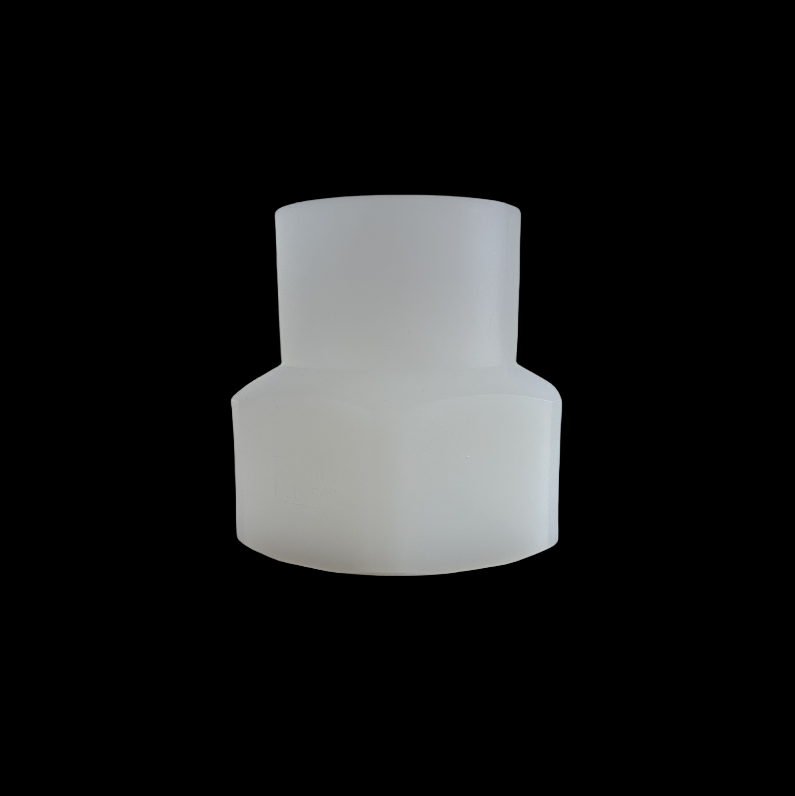
Procuring custom fluoroplastic parts involves rigid supply chain constraints. Unlike common commodity plastics, fluoropolymers belong to a highly regulated, premium material tier. You must understand how raw material sourcing cascades down to your final quote.
Manufacturers rarely synthesize their own resin. They purchase PVDF resin pellets or extruded rod stock from massive global compounders like Solvay or Arkema. These industrial chemical giants impose strict bulk purchasing minimums on the component manufacturer. If your project demands a highly specific material grade, such as FDA-compliant resin or ultra-high purity grades for semiconductor fabrication, those bulk minimums get passed directly to you.
Factory operations do not run perfectly on the first try. Let us examine the reality of industrial injection molding setup.
These test shots consume premium raw material. The financial cost of wasted resin during this calibration phase is staggering. Manufacturers mandate a higher MOQ strictly to ensure they maintain profitability per batch after absorbing these setup losses.
Sometimes you need specialized mechanical properties. Adding carbon fiber for structural strength alters the material flow rate. Requesting specific safety pigments requires specialized compounding runs. Every unique additive exponentially increases your MOQ. Suppliers must halt standard production, clean the hoppers thoroughly, and run custom batches just for your order.
Every procurement professional eventually faces the impossible triangle. You simply cannot simultaneously secure low MOQs, short lead times, and low unit costs. Recognizing these inherent trade-offs prevents supply chain bottlenecks and protects your operating budget.
Decisions require sacrifice. If you demand speed, you will forfeit cost efficiency. If you demand rock-bottom unit pricing, you must commit to massive volumes and endure longer waits. Let us explore two common scenarios.
We recommend calculating a strict "break-even" point. Map out your expected annual consumption. Multiply the high CNC unit cost by your required volume. Then, compare that figure against the combined cost of custom tooling plus the lower injection-molded unit price. When the molded total dips below the machined total, you possess the financial justification to transition away from CNC processing.
Buyers often express frustration when quoted a 12-week delivery schedule. They wonder why shaping plastic takes a full business quarter. The reality is that producing reliable custom PVDF fittings requires intense front-loaded engineering. Actual production forms only a fraction of the timeline.
Design for Manufacturing (DFM) serves as the critical first step. Engineers validate your CAD files for moldability. They check wall thicknesses and draft angles. PVDF behaves quite differently than standard PVC or PP during the cooling phase. It exhibits significant anisotropic shrinkage. Tooling designers must oversize the mold cavities precisely to ensure the final cooled part matches your dimensional requirements.
Cutting raw steel demands time. Tooling for fluoropolymers requires highly polished surfaces. Furthermore, molten PVDF releases mildly corrosive off-gassing during processing. Standard steel molds will pit and degrade quickly. Therefore, manufacturers often apply specialized nickel-alloy coatings or hard chrome plating to the mold surfaces. This necessary metallurgical protection adds weeks to the fabrication schedule.
The factory produces the very first physical samples once the mold finishes. Quality control teams measure dimensional accuracy using coordinate measuring machines (CMM). They conduct pressure tests to verify integrity. This phase proves especially critical for threaded connections or systems handling volatile chemicals. The clock also ticks while the factory awaits your formal engineering sign-off.
Once you approve the FAI samples, the actual mass manufacturing begins. Ironically, this final step is usually the fastest part of the entire process. Injection molding machines cycle rapidly, churning out hundreds of flawless parts per hour.
You do not have to accept long lead times passively. Savvy procurement teams deploy several proven strategies to manipulate the schedule and volume requirements in their favor. Consider these proactive approaches before submitting your next purchase order.
Ask your engineering team a simple question: Can we utilize a standard commercial body and only customize the connection ends? Modifying an existing component drastically reduces your tooling costs. It also slashes lead times. By employing a hybrid approach, you avoid paying for an entirely new non-standard pipe fitting mold from scratch.
Negotiate an annual blanket contract with your supplier. The manufacturer agrees to produce the high MOQ upfront to gain their necessary production efficiency. However, they hold the bulk inventory in their warehouse. They ship products to your facility in smaller, manageable monthly batches. You only receive billing upon shipment. This strategy guarantees stock availability while protecting your immediate cash flow.
Incomplete drawings ruin schedules. Changing specifications midway through the DFM review remains the number one cause of unexpected lead-time delays. Ensure your engineering team provides locked, production-ready 3D models and fully toleranced 2D prints on day one.
Global supply chains remain volatile. If your primary resin choice becomes suddenly backordered, production halts completely. You can prevent this bottleneck by pre-approving equivalent material grades during the initial design phase. For example, testing and allowing a switch from Solef to Kynar resin ensures the factory can pivot seamlessly depending on current market availability.
Evaluating a manufacturing partner goes far beyond hunting for the lowest per-part quote. Securing reliable components requires analyzing a supplier's internal tooling capabilities, their direct access to premium raw materials, and their overall transparency regarding setup constraints. The cheapest quote often hides disastrous delays.
You must shift your focus from piece-price to process predictability. Take control of your supply chain by implementing these clear action steps:
A: Raw material cost disparity drives this difference. PVDF resin is significantly more expensive than standard PVC. When a factory calibrates machines, they must purge old plastic using the new resin. The financial loss generated by wasting premium fluoropolymers during this setup phase is substantial. Manufacturers require larger production runs solely to absorb this unavoidable material cost.
A: Yes, many flexible manufacturers permit "short runs." However, the buyer must agree to pay a separate lot charge or an upfront setup fee. This supplemental charge covers the dedicated machine time and the expensive wasted resin. You are effectively subsidizing the financial losses created by your low volume request.
A: Yes. Precision threads demand complex mold mechanisms, such as automated unscrewing cores or collapsible sections. Sometimes, they require secondary CNC machining operations after the initial molding phase. These specialized mechanical requirements add significant tooling fabrication time and extend the final production schedule.
A: FAI processes generally span 1 to 3 weeks. The exact duration depends entirely on the rigor of the testing protocols required. High-pressure testing and comprehensive dimensional reporting take days to compile. Furthermore, the timeline often hinges on the speed of the buyer's own internal engineering approval process once samples arrive.


