
close
Choose Your Site
Global
Social Media


Views: 0 Author: Site Editor Publish Time: 2026-07-30 Origin: Site


Specifying pipe fittings for industrial applications carries incredibly high stakes. Aggressive chemicals and high-pressure fluid transfers leave absolutely no margin for error. A mismatched fitting often leads to severe thread galling, hazardous chemical leaks, or catastrophic pressure blowouts. To prevent these dangerous failures, buyers must look beyond basic material properties. Instead, engineers and procurement teams must scrutinize the exact dimensional, mechanical, and compliance data. You need these details to evaluate a PPH male connector for safe, long-term deployment.
Knowing these critical specifications prevents costly system shutdowns and mitigates safety risks. We will guide you through the precise engineering criteria necessary to shortlist components effectively. You will learn how to read thermal de-rating curves, compare thread tolerances, and validate supplier quality accurately. This knowledge ensures your pipeline connections remain completely leak-free under extreme stress.
Improperly specified fittings compromise your entire piping network. Small deviations in thread pitch or material density can cause compounding mechanical failures over time. We see these errors manifest quickly in demanding industrial environments.
An incorrect specification directly threatens system integrity. Mechanical failures often begin as microscopic stress cracks. These cracks propagate when engineers ignore exact dimensional tolerances. Here are the primary system risks to watch out for:
Engineers typically choose Polypropylene Homopolymer (PPH) for its outstanding chemical resistance. It easily handles harsh acids, alkalis, and organic solvents. However, you must carefully select an industrial fluid lines PPH male connector to preserve these advantages. If the physical connector specifications are wrong, the chemical resistance means nothing. Poor wall thickness allows aggressive fluids to permeate and degrade the fitting base. An improper seal also exposes the underlying pipeline infrastructure to corrosive fluid damage.
Evaluating standard data sheets requires attention to detail. You must decode the exact numbers separating a reliable fitting from a failure hazard. Let us examine the fundamental PPH male connector specifications you must review.
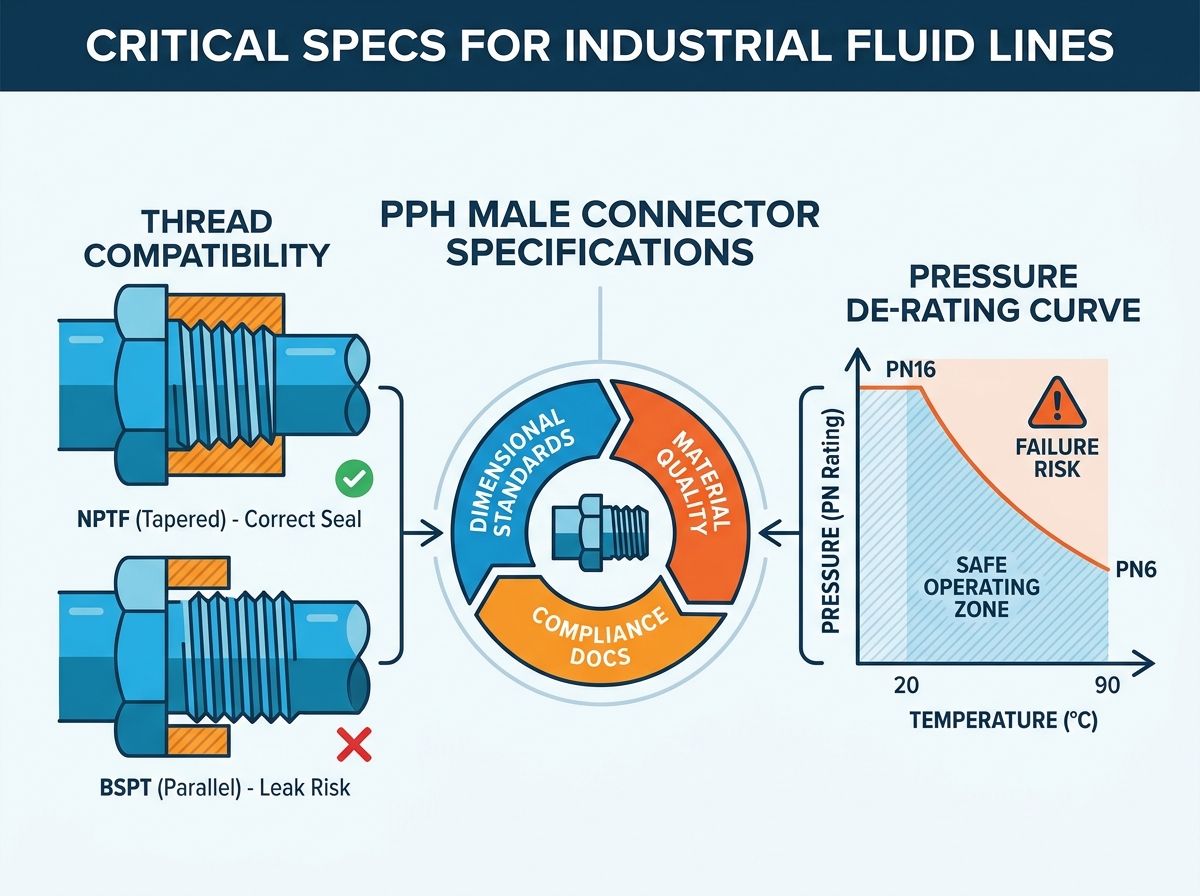
Thread mismatch is the leading cause of joint failure in plastic piping. You must align the male adapter threads perfectly with the female port. The two most common industrial thread standards are NPT/NPTF and BSPT/BSPP. They are not interchangeable. Forcing an NPT fitting into a BSPT port will destroy the plastic threads.
NPT (National Pipe Taper) features a 60-degree thread angle. BSPT (British Standard Pipe Taper) uses a 55-degree angle. Tapered threads create a mechanical seal by wedging together. They form an interference fit. However, you must avoid over-tightening plastic threads. Excessive torque splits the female port or shears the male threads entirely. A proper specification dictates the exact thread engagement length required for a safe seal.
Thread Standard Comparison Chart
| Specification Metric | NPT / NPTF | BSPT / BSPP |
|---|---|---|
| Thread Angle | 60 Degrees | 55 Degrees |
| Thread Shape | Flattened peaks and valleys | Rounded peaks and valleys |
| Sealing Mechanism | Interference fit (requires tape/sealant) | Interference fit (BSPT) or O-ring (BSPP) |
| Primary Region | North America | Europe, Asia, Global |
You cannot evaluate pressure and temperature independently. They function as a combined performance matrix. First, define the Nominal Pressure (PN) class. PN10 fittings handle 10 bar (145 psi) at room temperature. PN16 fittings manage 16 bar (232 psi). This baseline only applies at 20°C (68°F).
Thermoplastics exhibit thermal de-rating. As the system temperature increases, the maximum allowable working pressure drops significantly. PPH typically reaches its upper operational limit between 90°C and 100°C. If you pump 80°C fluid through a PN16 fitting, the safe working pressure might fall below 6 bar. Always demand a thermal de-rating curve from the manufacturer. Calculate your maximum operational stress against this degraded curve to ensure a healthy safety margin.
Global dimensional standards govern how these fittings integrate into broader systems. You must verify compliance against recognized engineering frameworks. Evaluating these frameworks prevents integration headaches later.
Wall thickness plays a massive role in burst strength. Engineers measure this using the Standard Dimension Ratio (SDR). SDR represents the ratio of the pipe's outer diameter to its wall thickness. A lower SDR means a thicker wall. A thick wall around the connector base resists hydrostatic pressure and minimizes dangerous flow restrictions.
The method you use to join the pipeline determines installation speed and joint longevity. Buyers must choose between traditional threaded mechanisms and modern push-to-connect designs. Each style serves a distinct industrial purpose.
Traditional threaded male adapters require rotational torque for installation. You apply PTFE tape and wrench the fitting into place. This creates a highly secure, permanent mechanical bond. Conversely, push-to-connect male fittings use internal grab rings and O-rings. You push the pipe straight into the fitting. The stainless steel grab teeth bite into the pipe exterior. The internal O-ring compresses to form the fluid seal.
Standard threaded connectors dominate high-pressure environments. We strongly recommend them for permanent, aggressive chemical lines. They handle stress spikes reliably. Threads also resist lateral pull-out forces better than friction-based systems.
Push-to-connect designs excel in rapid assembly scenarios. Maintenance teams prefer them when space is tight. They eliminate the need for bulky wrenches. Furthermore, push-to-connect systems handle vibration-heavy environments well. The internal O-ring provides slight flexibility, absorbing minor mechanical shocks safely.
If you specify a push-to-connect fitting, the seal material becomes your weakest link. The PPH body might resist hydrochloric acid perfectly, but an incompatible O-ring will dissolve. You must specify seal materials carefully.
Standard catalogs cover most industrial needs. However, specific engineering challenges demand tailored solutions. Buying off-the-shelf parts for highly specialized equipment often forces unacceptable compromises.
You should specify a custom PPH male connector when standard specs fall short. Common triggers include unique OEM equipment interfaces requiring non-standard thread pitches. Sometimes, a restricted spatial envelope demands a shorter thread length or a low-profile hexagonal grip. Additionally, if you need hybrid transitions—such as adapting a metric pipe to a specialized imperial port—custom manufacturing becomes necessary. Do not force standard parts into non-standard holes.
Discussing custom parts with a manufacturer requires understanding their production capabilities. For high-volume orders, injection mold design is critical. The mold must account for the natural shrinkage rate of cooling PPH resin. Poor tooling causes warped threads. If you only need a low-volume run, inquire about CNC machining capabilities. CNC machining solid PPH billets offers incredible precision without the heavy upfront cost of mold tooling.
Never deploy a custom part without rigorous validation. You must mandate strict testing protocols before accepting delivery. Common practices include hydrostatic pressure testing to verify seal integrity. Burst testing pushes the fitting to absolute failure, determining the true safety margin. Finally, dimensional verification using optical comparators ensures the custom threads match your exact engineering drawings.
Finding a reliable component means finding a reliable partner. A brilliant engineering specification fails if the factory cuts corners on the production floor. You must audit your supply chain stringently.
Top-tier suppliers guarantee 100% virgin PPH resin. Recycled plastics introduce impurities and compromise molecular chain integrity. This degrades both chemical resistance and mechanical strength. You must request Material Test Reports (MTRs) for every batch. These documents trace the exact chemical composition of the raw polymer back to the original resin manufacturer. Verifiable traceability prevents catastrophic field failures.
Investigate the factory's internal quality infrastructure. You want a PPH male connector supplier holding active ISO 9001 certification. Walk away from manufacturers lacking documented QC processes. Look for automated optical inspection (AOI) systems on their line. AOI scans every fitting for micro-fractures and thread deformities. Additionally, ask for their batch pressure testing records. Reputable facilities routinely test random samples from every production run to failure.
Procurement realities dictate project success just as much as engineering specs. Evaluate the supplier's Minimum Order Quantities (MOQs). High MOQs tie up unnecessary capital. Scrutinize their packaging specifications closely. PPH threads are tough but vulnerable to impact damage during transit. The supplier must use protective thread caps or individual polybagging for bulk industrial orders. Finally, establish firm lead times to prevent costly project delays.
Buying the right PPH male connector is an exercise in rigorous technical matching. You must align exact dimensional standards, thread pitches, and interface tolerances. You must evaluate pressure-temperature de-rating curves against your actual operating environment. Furthermore, matching chemical requirements to both the PPH body and the internal seals guarantees system longevity. Skipping any of these steps invites mechanical failure.
Your next step is straightforward. Never finalize a purchase order based on a simple website description. Always contact the manufacturer and request a comprehensive Technical Data Sheet (TDS). Review the detailed engineering drawings. Initiate a sampling process to test thread engagement physically. Taking these precise actions ensures your industrial fluid lines remain secure, compliant, and hazard-free.
A: A standard PPH male connector typically maxes out between 90°C and 100°C. However, you cannot operate at maximum pressure at this temperature. PPH loses mechanical strength as it heats up. You must apply a thermal de-rating curve to calculate the safe working pressure at elevated temperatures.
A: Always use high-density PTFE tape wrapped in the direction of the thread. Avoid liquid pipe dopes, as certain chemical bases degrade plastics. Never over-tighten the fitting. Follow the manufacturer's specific torque limits. Hand-tighten first, then use a strap wrench for the final half-turn to prevent cracking.
A: Standard PPH degrades under prolonged ultraviolet light exposure, becoming brittle over time. If you install the connector outdoors, you must specify a UV-stabilized PPH variant. Alternatively, you can use external shielding or paint the fitting with compatible protective coatings to block direct sunlight.
A: You must provide a complete engineering checklist. This includes the outer diameter (OD) of the pipe, exact thread standard (NPT/BSPT) and size, required PN rating, and the specific fluid medium. You must also detail the normal and peak operating temperatures to ensure accurate material selection.


