
close
Choose Your Site
Global
Social Media


Views: 0 Author: Site Editor Publish Time: 2026-08-30 Origin: Site


High stakes define bulk procurement in critical fluid and gas systems today. A single compromised fitting can easily cause catastrophic system contamination. It can trigger unplanned manufacturing downtime or lead to devastating batch loss. Procurement teams face a massive challenge here. You must balance the demands of vast scale and aggressive lead times. Simultaneously, you must ensure uncompromised metallurgical integrity and flawless surface finishes. Achieving this balance requires strict adherence to precise engineering tolerances. Navigating this complexity demands a reliable framework. This article provides a pragmatic, evidence-based checklist for both engineering and procurement professionals. You will learn exactly how to evaluate technical standards. We will show you how to vet potential manufacturing partners efficiently. We will also help you define complex custom requirements accurately. Use this comprehensive guide to optimize your strategy before issuing your next high-volume purchase order.
Material composition serves as the foundation for any high purity system. You should require 316L stainless steel as your absolute baseline material. This specific low-carbon alloy prevents carbide precipitation during welding. Engineers must evaluate the necessity of VIM/VAR processing for ultra-high purity (UHP) gas lines. Vacuum Induction Melting and Vacuum Arc Remelting remove non-metallic inclusions. They effectively eliminate micro-voids in the steel matrix. Adhering to strict high purity pipe fitting specifications guarantees predictable installation outcomes. You must meticulously verify sulfur content limits in the mill test certificates. Maintain sulfur levels strictly between 0.005% and 0.017%. This precise range ensures optimal orbital weldability. Sulfur acts as a critical surfactant in the molten weld pool. Controlling it prevents irregular weld pool shifting and inconsistent penetration depth.
Surface roughness dictates the cleanability and corrosion resistance of the component. You must establish maximum acceptable internal surface roughness limits immediately. Standard purity applications generally require an Ra value of ≤ 15 µin. UHP gas delivery systems demand an Ra of ≤ 5 µin. Achieve this through rigorous electropolishing (EP). Check for standardized electropolishing and chemical passivation processes. These treatments preferentially dissolve iron from the surface layer. They leave behind a robust, chromium-enriched passive layer. This chromium oxide barrier protects against localized pitting and rouge formation.
Manufacturing excellence means nothing if components arrive contaminated. You must mandate stringent final cleaning protocols. Facilities should use hot Deionized (DI) water ultrasonic baths. They must purge components using highly filtered, heated nitrogen gas. Verify the physical location of the final packaging process. Suppliers must perform packaging inside an ISO Class 4 (Class 10) or Class 5 (Class 100) cleanroom environment. Workers must use dual-bagged anti-static polyethylene materials. The inner bag should maintain a vacuum seal or a pure nitrogen purge. This protects the internal geometry from airborne particulates during global transit.
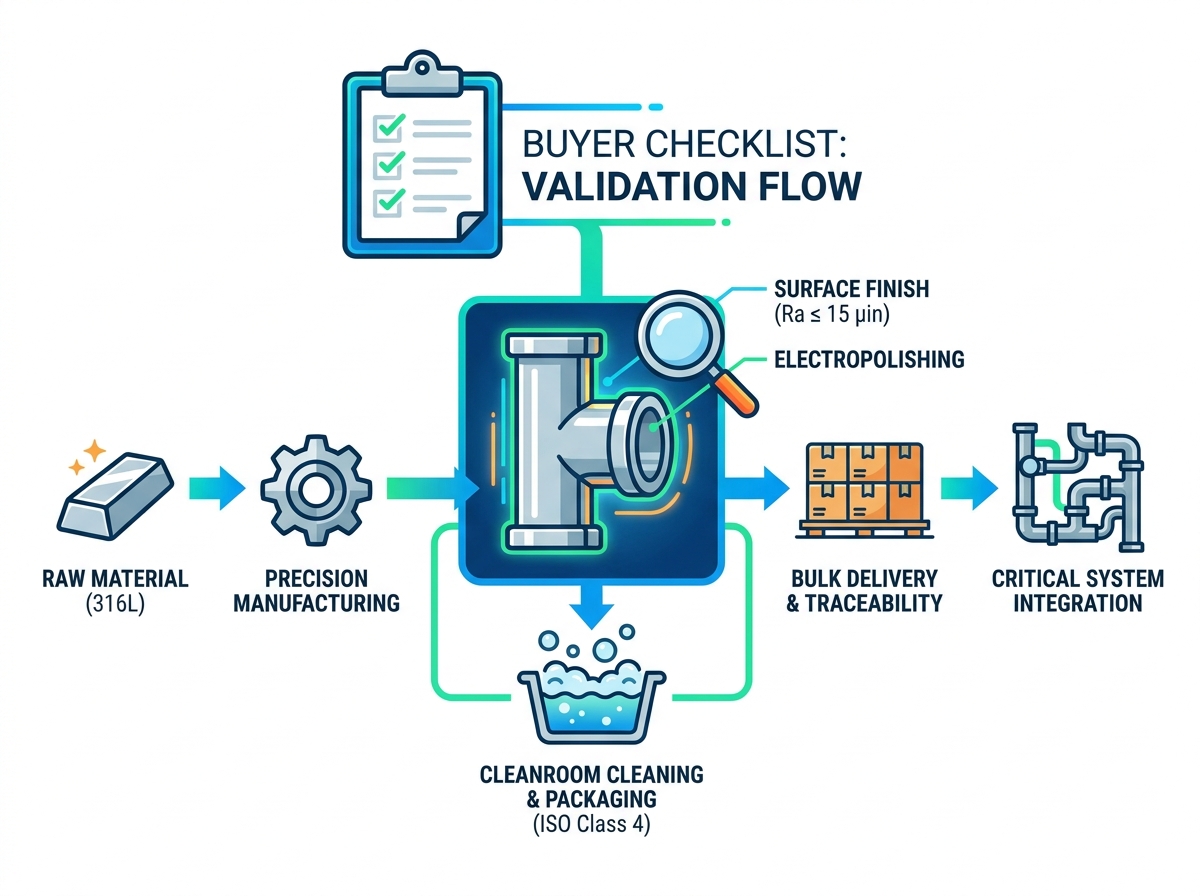
Different production environments impose radically different performance thresholds on fluid networks. You must adjust your procurement checklist to match these precise industry realities.
Fabrication plants operate on microscopic margins of error. You must focus aggressively on absolute particulate elimination. Buyers should prioritize zero-leak-rate geometries across the board. Engineers typically specify VCR-compatible metal gasket face seal fittings. These designs prevent virtual leaks and particle entrapment. You must evaluate specific ultra-high vacuum (UHV) requirements carefully. Understand the minimal outgassing thresholds allowed by your process engineering team. Even microscopic metallic outgassing can ruin a silicon wafer batch.
Photovoltaic cell production introduces intense chemical challenges. You need specialized components, such as a reliable solar manufacturing high purity pipe fitting, to handle harsh conditions. You must assess compatibility with highly corrosive precursor gases. PECVD processes rely heavily on volatile gases like Silane and Ammonia. These toxic substances demand flawless metallurgical integrity to prevent auto-ignition or fatal leaks. Verify the material's inherent resistance to stress corrosion cracking. High-throughput cell production environments experience continuous thermal and pressure cycling. Your chosen alloy must withstand these relentless operational stresses.
Life science and food production facilities prioritize biological sterility above all else. You must check for rigorous ASME BPE compliance. This standard dictates precise dimensional tolerances and surface finishes. It ensures zero dead legs within the piping system network. Components must feature completely drainable geometries. Fluid entrapment allows bacterial biofilms to flourish. Proper slope and flawless internal finishes prevent this catastrophic bacterial entrapment entirely.
Off-the-shelf components provide immense logistical advantages for bulk buyers. They remain optimal for standard tube routing throughout major facility builds. Standardized geometries significantly minimize procurement lead times. You can easily leverage economies of scale to optimize your budget. They serve best for facility-wide gas distribution networks. Standard bulk gases exhibit highly predictable pressure metrics. Standard fittings handle these conventional flow dynamics safely and efficiently.
Sometimes standard catalogs cannot meet complex engineering demands. You must carefully evaluate the real ROI of custom manifolds. Hybrid adapters can effectively eliminate redundant connections within tight spaces. Reducing mechanical connection points directly reduces potential system leak points. A well-designed custom high purity pipe fitting can simplify complex system footprints. However, you must assess the associated engineering costs realistically. Account for validation timeline extensions required by quality assurance teams. Non-standard exotic alloys like Hastelloy or Monel drastically increase manufacturing complexity.
Use this rigorous checklist for all custom engineering orders:
Paperwork proves purity in the critical fluid transport industry. You must demand comprehensive Material Test Reports (MTRs) for every batch. Require compliance with the EN 10204 3.1 standard as a strict minimum. This independent certification confirms exact chemical composition and mechanical properties. A trusted high purity pipe fitting supplier will guarantee this transparency. Verify heat number traceability on the product itself. The factory must laser-etch this unique identifier directly onto every bulk fitting. It allows instant backward tracking to the original steel melt.
Do not rely solely on external certifications. You must audit the supplier’s internal testing protocols personally. Request detailed procedures for their Helium leak testing operations. The industry standard requires passing tests to $1 \times 10^{-9}$ std cm³/s. Review their moisture analysis capabilities and testing frequency. Examine their methodology for verifying surface particle counts. Suppliers must possess state-of-the-art metrology equipment to guarantee UHP standards consistently.
Brilliant engineering fails if the factory cannot deliver on time. Evaluate the manufacturer’s raw material inventory reserves closely. Strong reserves buffer your projects against unpredictable global alloy shortages. Review their historical OEM defect resolution policies. Ask for documented proof of historical on-time delivery rates for bulk shipments. You need partners who can surge production safely without cutting corners.
| Assessment Category | Critical Metrics to Evaluate | Red Flags to Avoid |
|---|---|---|
| Traceability | EN 10204 3.1 MTRs, Laser-etched heat numbers | Missing mill certificates, generic batch codes |
| Testing Protocols | Helium leak testing, particle count reports | Reliance on visual inspection only |
| Cleanroom Standards | ISO Class 4/5 packaging, dual-bagging | Open-air packaging, single plastic wrapping |
| Capacity Metrics | Raw alloy stockpiles, verifiable OTD rates | Just-in-time reliance, opaque lead times |
Variances inevitably occur when scaling production to massive volumes. You face significant risks regarding electropolishing quality across a 5,000-piece order. Some units might show unacceptable hazing or incomplete passivation. You must implement robust AQL (Acceptable Quality Limit) sampling immediately upon receipt. Do this before integrating any components into your cleanroom inventory. Random statistical sampling catches systemic manufacturing drifts early. It prevents defective batches from contaminating your pristine assembly lines.
The global supply chain hides severe metallurgical risks. Substandard offshore alloys often masquerade as premium components. Utilizing a counterfeit high purity pipe fitting leads to disaster. It causes rogue rouging in pharmaceutical water systems. It triggers systemic corrosion in reactive gas lines. You can mitigate this risk effectively through strict vetting. Only engage suppliers who enthusiastically allow third-party metallurgical audits. Require regular PMI (Positive Material Identification) testing. Handheld XRF analyzers can verify the exact alloy composition on your receiving dock instantly.
Factory purity vanishes if your team mishandles the product onsite. Contamination frequently occurs due to compromised cleanroom bags. Transit vibration or careless unboxing can puncture the protective anti-static polyethylene. You must establish extremely strict internal receiving protocols. Mandate careful visual inspection of all dual-bag vacuum seals. Technicians must perform this check prior to cleanroom entry. Any breached bag requires immediate quarantine and component recleaning.
Rigorous upfront specification forms the absolute foundation of long-term system integrity. You cannot compromise on metallurgical standards or surface finishing metrics. Bulk buying decisions demand hard, verifiable data above all else. Rely entirely on MTRs, precise Ra reports, and documented leak tests. Never let unit price alone dictate your critical sourcing strategy. Defective installations cost exponentially more than premium parts.
Take proactive steps today to secure your fluid networks. First, prompt your procurement teams to initiate comprehensive supplier audits immediately. Next, request detailed technical data sheets for all standardized components. Finally, submit detailed RFQs utilizing the precise checklists provided in this framework. Ensure your next bulk order meets the highest purity standards possible.
A: Standard high purity applications typically require a maximum internal surface roughness (Ra) of 15 µin. Ultra-high purity (UHP) gas delivery systems demand much tighter tolerances. You should specify an Ra of ≤ 5 µin for UHP applications. Manufacturers achieve these microscopic finishes through precision electropolishing.
A: Electropolishing actively removes microscopic peaks and valleys on the metal surface. This electrochemical process preferentially strips iron away from the outer layer. It leaves behind a highly concentrated, resilient chromium oxide passive layer. This barrier drastically improves resistance to localized corrosion, pitting, and rouge formation.
A: Sulfur acts as an active surfactant within the molten weld pool. You must maintain sulfur content strictly between 0.005% and 0.017%. This precise concentration ensures the weld pool penetrates deeply and consistently. Incorrect sulfur levels cause weld shifting and erratic bead profiles, ruining system integrity.
A: You must demand an EN 10204 3.1 Material Test Report (MTR) for every batch. Require certified reports for internal surface roughness (Ra). Ask for documented Helium leak test results. Finally, ensure all components arrive with matching laser-etched heat numbers for complete material traceability.


