
close
Choose Your Site
Global
Social Media


Views: 0 Author: Site Editor Publish Time: 2026-08-08 Origin: Site


Semiconductor manufacturing operates in a zero-margin-for-error environment. A single micro-contamination event or chemical leak inside the sub-fab can trigger catastrophic yield losses. Such incidents also cause severe facility downtime. Standard industrial plastics like PVC or standard PP fail under these extreme conditions. They cannot withstand aggressive chemicals like hydrofluoric or sulfuric acid. They also fall short of the ultra-pure water (UPW) requirements demanded by modern node architectures.
Engineers must protect multi-billion-dollar facility investments from these critical vulnerabilities. They must move beyond generic material selection. Evaluating exact fitting designs, joining methodologies, and supplier validation frameworks is now essential for long-term operational success.
Polyvinylidene Fluoride (PVDF) stands out among high-performance polymers. PTFE and PFA offer exceptional chemical resistance. However, they lack structural rigidity. They also cost significantly more. PVDF bridges this gap perfectly. It provides an exceptional mechanical rigidity-to-cost ratio without sacrificing chemical inertness. It handles aggressive acids effortlessly. Thermal stability remains incredibly high under dynamic stress. You can rely on it entirely for critical fluid handling.
Selecting the right joining methodology dictates the long-term safety of your fluid systems. You must match the connection type to the specific application.
Infrared (IR) Butt Welding: This represents the absolute gold standard for UPW lines. Traditional fusion creates a physical weld bead. Beads trap particulates and foster bacterial biofilm growth. Non-contact infrared (IR) welding eliminates this flaw entirely. It uses precise radiant heat to melt pipe ends. The resulting joint features a perfectly smooth internal bore. You eliminate physical contact during the heating phase. This slashes contamination risks drastically.
Socket Fusion: You can utilize socket fusion for less demanding chemical lines. Chemical waste systems and process cooling water (PCW) networks serve as excellent candidates. It provides highly reliable joints. It is also exceptionally cost-effective. However, you must avoid it for ultra-pure applications. The physical socket creates a microscopic crevice. Contaminants easily lodge inside this gap over time.
Mechanical/Flanged Connections: Equipment transitions require structural flexibility. Maintenance teams need fast access to valves and chemical pumps. Mechanical and flanged connections solve this issue. They allow modular assembly and disassembly. You must specify properly sized backing rings. Fluoroelastomer gaskets are equally critical. They prevent polymer creep under continuous fluid pressure. Poorly specified gaskets inevitably lead to catastrophic micro-leaks.
Engineers must meticulously evaluate PVDF pipe fitting specifications for dynamic pressure ratings. Standard components carry PN10 or PN16 nominal pressure ratings. These baseline ratings assume ambient temperatures (typically 20°C). Semiconductor fluids often operate at heavily elevated temperatures. Hot sulfuric acid is a prime example.
You must apply strict temperature de-rating factors. As fluid temperature rises, mechanical pressure capacity drops significantly. A PN16 fitting might only safely handle 4 bar of pressure at 90°C. You must consult specific de-rating curves for every chemical application. Ignoring these thermal realities compromises system integrity.
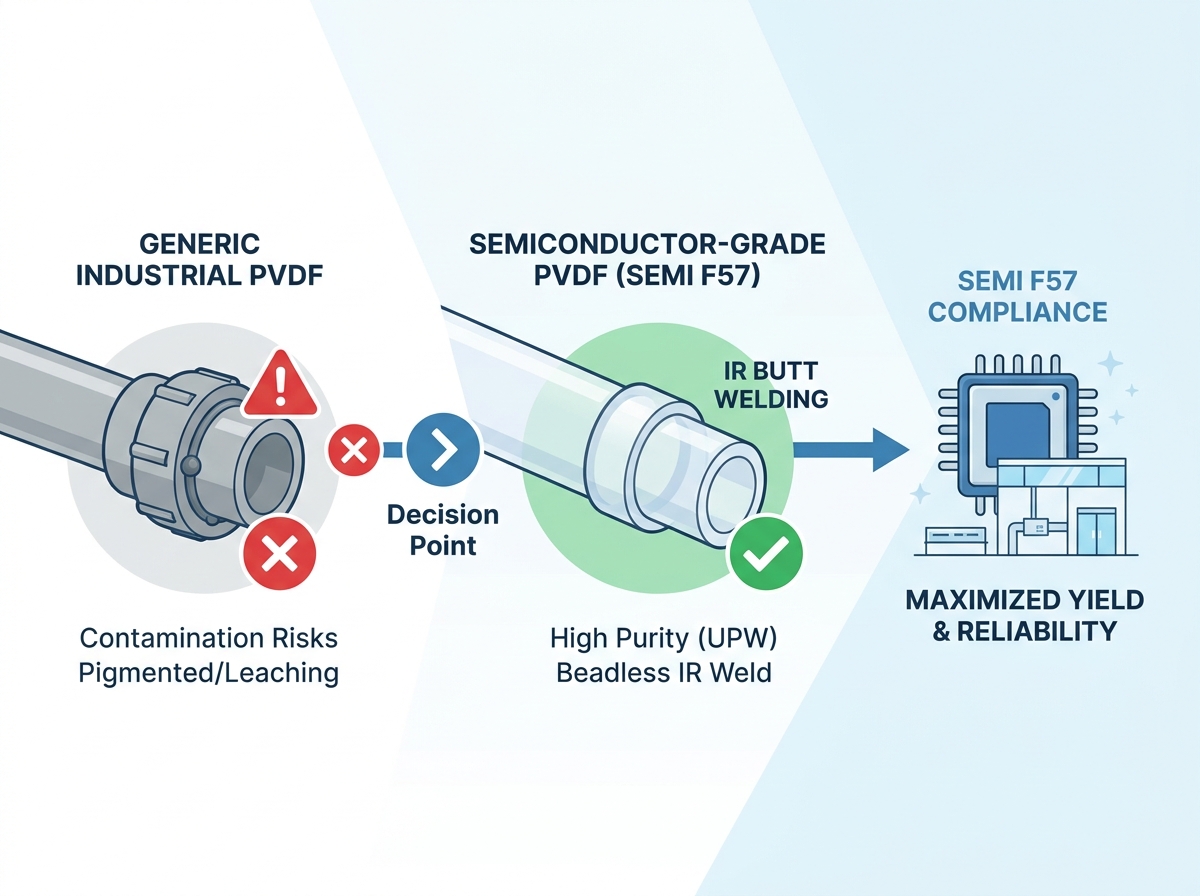
You cannot guess when specifying materials for semiconductor fabrication. You need concrete performance benchmarks. SEMI F57 serves as this non-negotiable standard. It governs polymer components used in high-purity liquid chemical distribution systems. It dictates acceptable limits for extractables. Any semiconductor plants PVDF pipe fitting must meet these rigorous criteria. If it fails, the entire production yield is at risk.
Manufacturers often color standard industrial plastics. This helps identify fluid lines visually. You must strictly avoid this practice in UPW applications. Pigments contain commercial dyes. Dyes inherently contain trace heavy metals. Aggressive chemicals and ultra-pure water will leach these metals out. This creates instant wafer contamination.
Instead, unpigmented (natural) PVDF is your only viable choice. Natural resin ensures ultra-low extractable levels. It keeps total organic carbon (TOC), anions, and trace metals near zero.
Comparison: Natural vs. Pigmented Resin Characteristics
| Feature | Unpigmented (Natural) PVDF | Pigmented PVDF |
|---|---|---|
| Visual Appearance | Translucent white / slightly opaque | Solid colors (red, blue, grey) |
| Heavy Metal Extractables | Extremely low (SEMI F57 compliant) | High risk of leaching |
| Primary Application | UPW, highly aggressive chemicals | Industrial waste, non-critical water |
| TOC Release | Near zero | Variable depending on dye used |
Chemical purity is only half the battle. Physical surface topography matters just as much. You must demand ultra-smooth internal surface finishes. Rough surfaces create microscopic valleys. Bacteria thrive in these valleys. Particulates also cling to rough walls.
A highly polished surface finish (measured in Ra) inhibits biofilm growth. It also prevents particulate shedding during high-velocity fluid transfer. A smooth bore maintains laminar flow, reducing friction and stress on the pump systems.
Do not accept generic marketing claims. Many manufacturers label products as "high purity." This label holds no technical weight. Advise your engineering teams to demand proof. Request third-party SEMI F57 compliance certificates. Independent laboratories must validate these claims. Ask for actual test data covering trace metals and extractables. Trust only verifiable scientific documentation when safeguarding fab infrastructure.
Sub-fab real estate is notoriously constrained. Facility designers pack equipment tightly to maximize cleanroom space. Chemical delivery modules (CDMs) require compact footprints. Valve manifold boxes (VMBs) face similar spatial limitations. Standard catalog dimensions often fail in these dense environments. Off-the-shelf geometries simply require too much physical room. You cannot route complex tubing safely using only standard elbows and tees.
You should pivot to a custom PVDF pipe fitting under several specific conditions. Relying on custom engineering solves unique architectural routing challenges.
Many procurement teams view custom parts as an added expense. You should reframe this perspective. Customization acts as a powerful risk-mitigation strategy. It dramatically reduces the total weld count in your system. Every weld represents a potential failure point. Fewer welds mean higher systemic reliability.
It also drastically lowers installation labor. Pre-fabricated components drop directly into place. Finally, custom geometries shrink the overall system footprint. This frees up invaluable sub-fab real estate for other critical infrastructure additions.
A superior PVDF pipe fitting requires a pristine origin. You cannot manufacture high-purity components in a dirty factory. A qualified PVDF pipe fitting supplier must utilize controlled environments. They must mold and package fittings inside ISO Class 5 cleanrooms. Some critical components require even better classifications. This strict environment prevents pre-installation contamination. If a fitting arrives dirty, it compromises the entire UPW system immediately.
Supply chain transparency ensures operational safety. You must mandate stringent QA protocols.
SEMI F57 is the baseline for purity. However, a top-tier supplier aligns with multiple global standards to guarantee overall system safety.
A supplier should act as a technical partner. Do not evaluate them solely on part availability. Evaluate their ability to provide on-site welder training. Proper IR welding requires exact parameter documentation. Ask if they supply chemical compatibility validation. Proprietary fab chemistries behave unpredictably. Your supplier should test their fittings against your specific chemical blends to guarantee long-term stability.
The right PVDF fitting design balances joint integrity, verifiable purity, and spatial efficiency. IR welding and unpigmented resins are absolute mandates for success. Relying on standard components for complex manifolds introduces unnecessary risks and wastes valuable sub-fab space.
You must rigorously apply shortlisting logic during procurement. Eliminate any design lacking pure, unpigmented resin for UPW applications. Rule out suppliers without traceable cleanroom manufacturing. Always prioritize systems offering seamless IR welding for your critical fluid paths.
Your next step is clear. Prompt the facility engineer or procurement lead to audit your current piping schematics. Contact a specialized supplier immediately. Request a comprehensive technical review, a chemical compatibility audit, or a custom manifold consultation to safeguard your facility operations.
A: Natural PVDF is unpigmented and completely free from chemical dyes. Pigmented PVDF contains additives for color-coding. In ultra-pure water (UPW) systems, you must use natural PVDF. Pigments carry significant risks of heavy metal leaching. As aggressive fluids pass through, these heavy metals dissolve into the stream, causing severe wafer contamination.
A: Yes, PVDF exhibits excellent resistance to high-concentration sulfuric acid. However, you must carefully calculate temperature de-rating factors. While PVDF handles 98% sulfuric acid at ambient temperatures, elevated temperatures drastically reduce its pressure capacity. Ensure your supplier validates the exact acid concentration and operating temperature for your specific fab application.
A: IR butt welding relies on radiant heat without physical contact between the heating element and the polymer. This prevents cross-contamination. More importantly, it eliminates internal weld beads and micro-crevices. Socket fusion creates physical gaps where bacteria and particulates accumulate. Perfectly smooth internal bores are mandatory to maintain UPW purity standards.
A: You should never rely on basic marketing claims. To verify compliance, demand third-party testing certificates from the manufacturer. Independent laboratories must evaluate the polymer for trace metals and total organic carbon (TOC) extractables. A legitimate supplier readily provides comprehensive test reports confirming their components strictly adhere to SEMI F57 limits.


