
close
Choose Your Site
Global
Social Media


Views: 0 Author: Site Editor Publish Time: 2026-08-12 Origin: Site


System engineers and procurement managers know the stakes. Fitting and connector failures do not just cause minor leaks. They trigger catastrophic micro-contamination risks and crippling production downtime. Every component in a critical fluid transfer loop must perform flawlessly.
Perfluoroalkoxy (PFA) has emerged as the definitive industry standard for advanced fluid handling. You see it everywhere today. It serves sensitive laboratory environments. It builds the backbone of massive semiconductor fabrication plants. This polymer bridges the gap between extreme chemical resistance and reliable mechanical stability.
This article strips away the marketing fluff to deliver an objective evaluation. We will explore how a PFA pipe connector secures system integrity and prevents costly failures. We break down exactly which technical parameters matter most. Finally, you will learn how to verify components and source them reliably for your next major installation.
Engineers must define success clearly in high-purity fluid systems. Success means achieving zero metallic ion extraction. It requires leak-free continuous flow under demanding conditions. It also demands optical clarity for visual inspections. We cannot accept anything less. Even microscopic deviations compromise the entire process yield.
Compromising on connector quality carries severe operational risks. Inferior components suffer from particle shedding. They shed microscopic plastic shards into the fluid stream. Poorly designed fittings also create dead-volume zones. These stagnant pockets breed bacterial contamination or trap residual chemicals. Furthermore, inferior plastics face rapid chemical degradation. They warp, crack, and ultimately fail when exposed to aggressive solvents.
Scaling these systems amplifies every risk. We call this the "Lab to Fab" scalability challenge. A small fluid loop in a research lab handles minor flow rates. A full-scale fabrication plant pushes thousands of liters continuously. Scaling demands uncompromising material consistency. You cannot simply swap materials during the transition. A reliable PFA pipe connector specifications sheet ensures your lab prototypes match your fabrication realities identically.
Common Mistakes to Avoid:
You must understand the material mechanics behind PFA. Why does it work so well? PFA is melt-processable. Manufacturers can injection-mold or extrude it seamlessly. This manufacturing method yields an exceptionally smooth internal surface finish. PTFE, by contrast, requires sintering. Sintering leaves microscopic voids. A high-purity fluids PFA pipe connector lacks these voids. This prevents bacteria and micro-particles from embedding in the walls.
Optical transparency provides another distinct operational advantage. Technicians need to visually monitor fluid flow. They must detect air bubbles instantly. They need to spot potential blockages without interrupting the system. PFA remains highly translucent. You can inspect the fluid line visually during active operations. This simple visual check prevents catastrophic pump failures caused by cavitation.
Ultra-low extractables define true system integrity. Semiconductor wet etch processes use highly aggressive chemicals. Biopharma applications handle delicate protein chains. PFA prevents metal ion contamination entirely. It does not leach zinc, iron, or copper into the fluid stream. This chemical inertness guarantees your high-stakes fluids remain perfectly pure from source to destination.
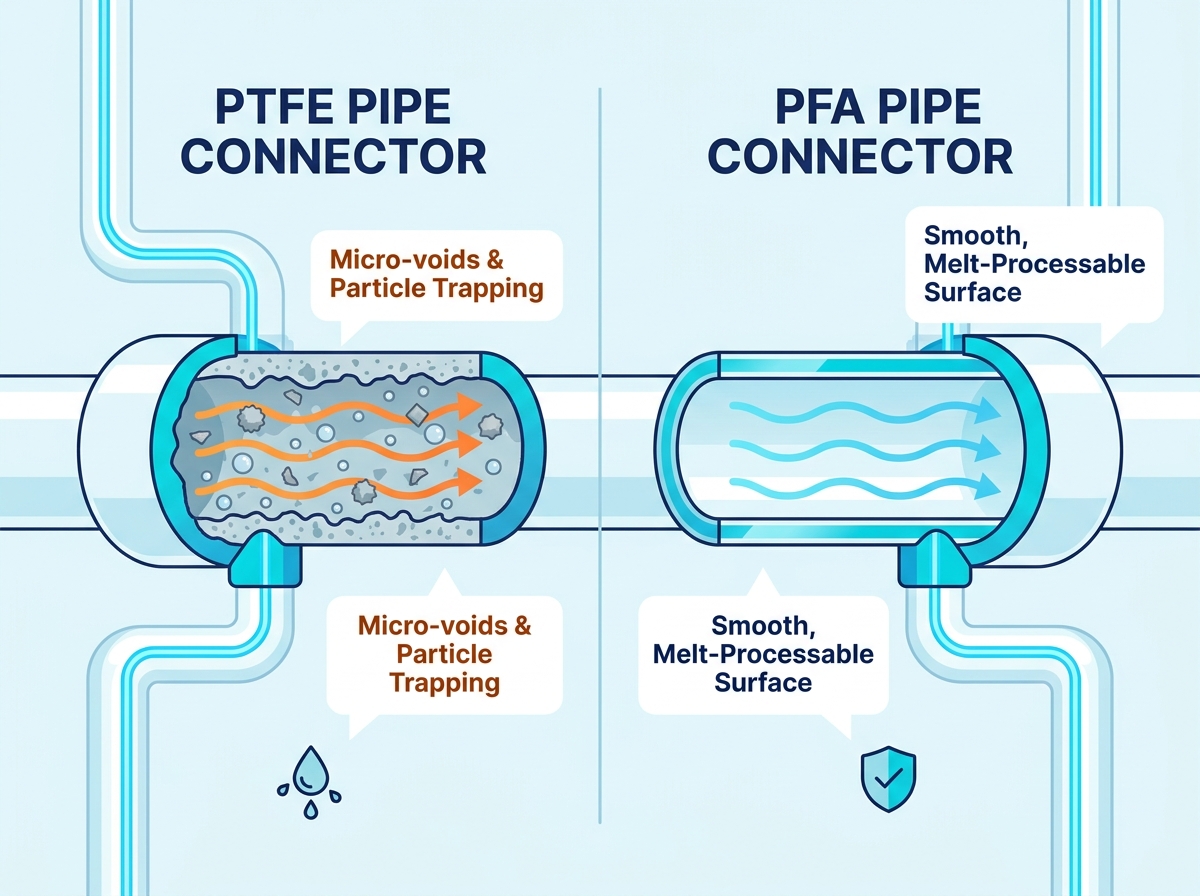
Engineers often debate between PFA and PTFE. We must evaluate them objectively based on structural density. Both materials share excellent chemical resistance. However, PFA offers superior resistance to gas permeability. PTFE’s sintered structure allows trace gases to permeate over time. PFA creates a denser, less porous barrier. This stops hazardous fumes from escaping the fluid line.
Mechanical stress reveals further differences. Flex life determines how long a connector survives continuous vibration. Diaphragm pumps create intense rhythmic pulsations. Thermal cycling expands and contracts the plastic joints. PFA maintains excellent flex life under these dynamic stresses. It resists cold flow better than PTFE. Cold flow causes fittings to loosen gradually, which inevitably leads to leaks.
We must also provide a balanced view. You do not always need PFA. When should you avoid it? If your application handles basic utility water, PFA represents overkill. If you do not require extreme purity, standard PTFE performs perfectly well. If optical clarity does not matter, standard opaque fluoropolymers work fine. Match the material rigorously to your specific application requirements.
| Performance Metric | PFA (Perfluoroalkoxy) | PTFE (Polytetrafluoroethylene) |
|---|---|---|
| Surface Finish | Ultra-smooth (Melt-processed) | Micro-porous (Sintered) |
| Optical Clarity | Translucent | Opaque White |
| Gas Permeability | Very Low | Moderate |
| Cold Flow Resistance | High | Low to Moderate |
Evaluating connection topologies is your first critical step. Different pressure profiles require different fitting styles. Flare fittings work exceptionally well for high-purity applications. They create a smooth, continuous flow path. Compression or pillar styles offer distinct advantages for high-pressure environments. They grip the tubing aggressively, preventing blowouts during pressure spikes. Choose the topology that matches your flow dynamics.
Pressure and temperature ratings define operational bounds. PFA performs reliably up to 200°C. However, you must derate the pressure capacity as temperatures rise. A connector holding 100 PSI at room temperature might only hold 40 PSI at 150°C. Always consult the manufacturer's temperature-pressure curve before finalizing your system design.
Buyers must scrutinize three key physical metrics. First, check the dimensional tolerances. Loose tolerances cause catastrophic leaks. Second, evaluate the thread integrity. Poorly machined threads strip easily during installation. Third, review the burst pressure data. Reliable manufacturers provide empirical testing data for these metrics. Never rely on theoretical calculations alone.
Regulatory compliance acts as your final filter. Semiconductor applications demand SEMI F57 certification. This standard guarantees ultra-low trace metal extractables. Medical and biopharma applications require FDA and USP Class VI compliance. These certifications verify the material remains non-toxic and biocompatible. Always request official compliance certificates before finalizing any procurement decision.
Best Practices for Specification Review:
Installation pitfalls destroy even the best components. Over-torquing represents the most common error. Technicians often tighten plastic fittings like metal ones. This crushes the ferrule and ruins the seal. Thermal expansion mismatch causes similar failures. When systems heat up, PFA expands differently than adjoining stainless steel ports. Improper routing also creates dead-legs, trapping fluids and ruining system purity.
Standard off-the-shelf components sometimes fail to fit. Unique footprints demand alternative solutions. You might need to retrofit proprietary legacy equipment. You might face extreme spatial constraints inside a crowded cleanroom cabinet. In these scenarios, forcing a standard fitting causes kinked tubes and restricted flow. You must deploy a custom PFA pipe connector to resolve these physical bottlenecks safely.
Custom engineering requires strict prototyping and testing protocols. You cannot simply sketch a design and deploy it instantly. You must test custom geometries under simulated operational stress. Subject the prototype to maximum thermal cycles. Run aggressive solvents through it to verify chemical inertness. Only approve the full rollout after the custom component passes these rigorous empirical tests.
Supply chain integrity dictates system reliability. You must rigorously vet your manufacturing partners. Cleanroom manufacturing is non-negotiable. Require Class 100 or Class 1000 cleanroom production environments. The manufacturer must wash all components with deionized (DI) water. They must package the fittings in double-sealed anti-static bags. Any exposure to ambient factory air contaminates the product before it even ships.
Material traceability protects your operational baseline. You need total transparency. Require official Certificates of Compliance (CoC) for every batch. Demand documentation showing the exact origin of the raw polymer resin. If a PFA pipe connector supplier cannot trace their resin back to the specific chemical lot, walk away immediately. Traceability ensures consistent performance across years of production.
Evaluate your shortlisted suppliers on broader operational criteria. Do they offer strong technical support capabilities? Can they assist with complex fluid dynamic calculations? Assess their lead-time stability. Supply chain shocks destroy production schedules. Finally, gauge their willingness to collaborate. A great supplier acts as an engineering partner, eager to co-develop custom geometries for your toughest challenges.
Upgrading to PFA components represents a calculated risk-mitigation strategy. High-stakes fluid systems cannot tolerate weak links. By leveraging melt-processable fluoropolymers, you eliminate micro-voids, prevent ionic leaching, and secure absolute chemical inertness. You also gain crucial optical transparency for safer daily operations.
Take immediate action to secure your infrastructure. First, audit your current fluid transfer components to identify degrading PTFE joints. Second, review your historical failure rates and pinpoint recurring leak zones. Finally, contact a specialized fluid engineering team for an application-specific consultation. Precision demands proactive upgrades.
A: Technically, you can reuse them, but we highly discourage it in high-purity environments. Tightening the fitting deforms the ferrule to create a seal. This cold flow means the plastic permanently changes shape. Reusing it risks microscopic leaks and dangerous particle generation. Always install fresh connectors for critical lines.
A: PFA handles aggressive acids flawlessly. It possesses near-universal chemical inertness. The carbon-fluorine bonds in the polymer matrix remain incredibly stable. Hydrofluoric (HF) acid and concentrated Nitric Acid will not degrade, soften, or permeate the PFA material under standard operational temperatures.
A: Custom components generally require realistic lead times between 6 to 12 weeks. This timeframe accounts for custom tooling fabrication, rapid prototyping, and rigorous empirical testing. Furthermore, specialized Class 100 cleanroom washing and packaging cycles add necessary days to ensure absolute purity before shipment.


