
close
Choose Your Site
Global
Social Media


Views: 0 Author: Site Editor Publish Time: 2026-08-17 Origin: Site


Specifying a Polytetrafluoroethylene (PTFE) core covers only half your procurement battle. The internal fluoropolymer handles harsh environments effortlessly. However, the external fitting material carries an equal burden. If this outer shell fails under high pressure, intense heat, or chemical exposure, the entire fluid assembly becomes a massive liability. Many buyers overlook the mechanical synergy required between the liner and the fitting body.
Selecting the wrong fitting material routinely causes micro-leaks. It introduces fluid contamination. It creates systemic pressure drops across your network. These mechanical failures directly escalate your maintenance workloads and introduce severe safety hazards into the facility. Relying on guesswork is not an option.
This article provides procurement engineers and technical buyers an evidence-based evaluation framework. You will learn how to specify correct metallic materials and tolerances for your fluid systems. We will also explore essential supplier criteria to ensure successful system configurations. You will walk away with actionable steps to upgrade your pipeline reliability.
Engineers value PTFE for its near-universal chemical resistance. The material effortlessly handles extreme high temperatures up to 500°F (260°C). It resists almost all industrial solvents. However, you cannot treat this advanced material like standard rubber. Many operators make the mistake of using standard rubber-compatible fittings on fluoropolymer hoses. This creates a severe mechanical mismatch.
We call this the "Weakest Link" principle. Standard rubber fittings rely on compression and surface friction to maintain a seal. PTFE has a notoriously low coefficient of friction. It acts like a slick, non-stick surface. Standard fittings simply cannot grip this material. When system pressure spikes, these incorrect fittings blow off catastrophically. Alternatively, they allow dangerous vapor leaks over time.
Buyers must establish strict success criteria when procuring these components. You need verifiable metrics to guarantee performance. First, demand zero vapor permeation. This remains absolutely critical when transferring volatile fuels, toxic acids, or noxious chemicals. Second, you must secure verified pressure ratings. The assembled unit must match or exceed the burst pressure limits of the host pipeline. Finally, evaluate galvanic compatibility. You must prevent dissimilar metal corrosion. If you attach an aluminum fitting to a carbon steel manifold in a damp environment, rapid galvanic corrosion will destroy the connection.
Best Practice: Always audit the surrounding environment. Consider washdown chemicals, ambient humidity, and adjoining equipment metals before approving a fitting material.
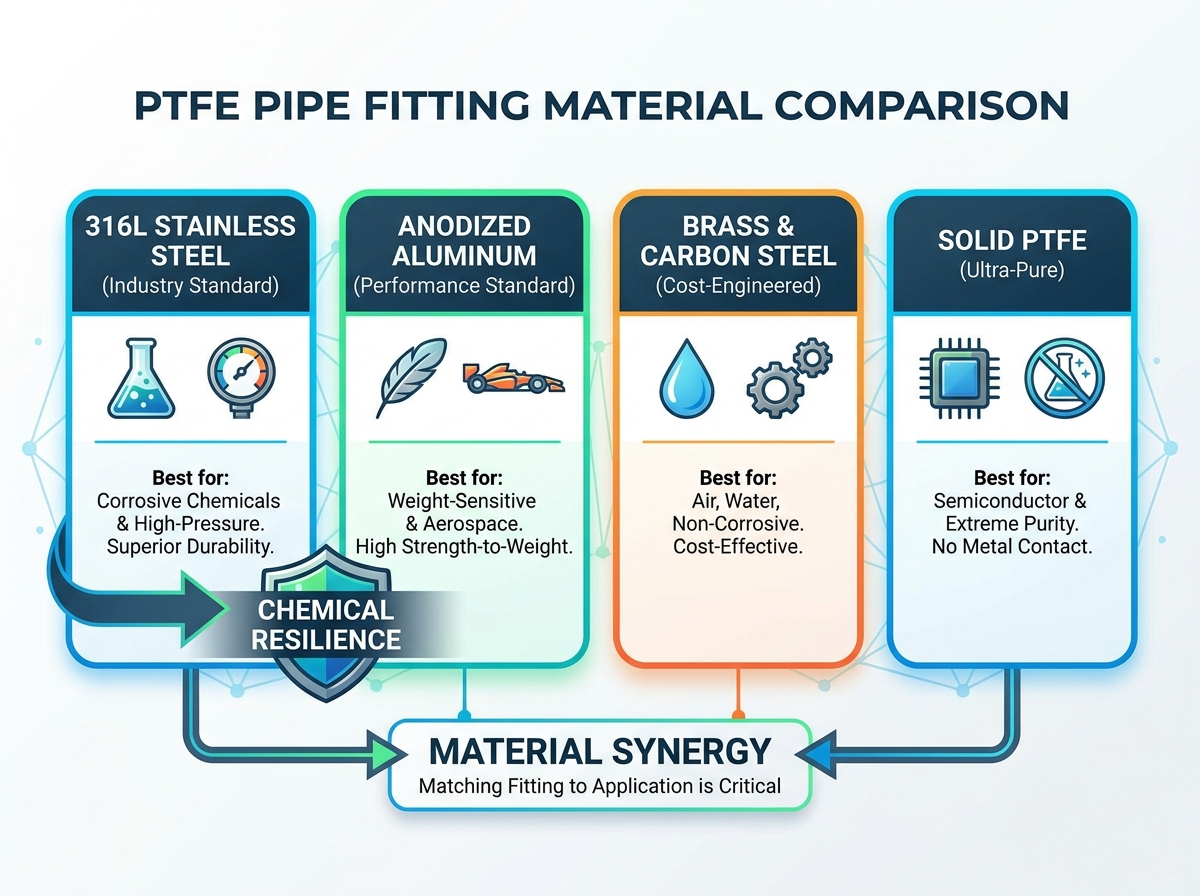
Matching the outer shell to the internal application determines long-term success. Different industries prioritize different metrics. Some need extreme chemical resistance. Others prioritize weight reduction. Here is how the primary materials stack up.
Stainless steel remains the undisputed heavyweight champion of fluid transfer. Most engineers specify 316L for demanding environments. It serves as the primary choice for high-pressure industrial lines, sanitary food-grade applications, and pharmaceutical processing. When you need a reliable corrosive chemicals PTFE pipe fitting, you should start your search here.
We must differentiate between the two common grades. 304 stainless offers good baseline corrosion resistance. However, 316L adds molybdenum to the alloy matrix. This addition drastically improves resistance to chlorides, saline environments, and harsh acidic washdowns. 316L represents the heaviest option. It also delivers the highest durability. If the pipeline operates near saltwater or handles aggressive chemicals, 316L is mandatory.
You will find anodized aluminum dominating automotive, aerospace, and motorsport applications. It forms the backbone of the standard AN (Army-Navy) fitting ecosystem. Engineers choose aluminum for one primary reason: weight reduction.
Aluminum offers an exceptional strength-to-weight ratio. It keeps vehicle mass low while handling high hydraulic pressures. However, it carries specific vulnerabilities. Anodized aluminum degrades rapidly when exposed to highly alkaline solutions. Harsh industrial acids will strip the anodized coating. Once the coating fails, the underlying raw aluminum oxidizes quickly. Keep aluminum in clean, weight-sensitive environments.
Facilities often rely on brass and carbon steel for less critical, controlled applications. These materials work perfectly well for standard air lines, clean water, and non-corrosive petroleum-based fluids. They keep procurement costs down.
You must watch out for specific chemical reactions. Brass poses severe dezincification risks in certain chemical environments. The zinc leaches out of the alloy, leaving a brittle, porous copper structure behind. Carbon steel presents a different problem. It rusts instantly upon moisture exposure. Manufacturers apply zinc plating to carbon steel to prevent this rust. Even with plating, you should never deploy carbon steel fittings for external weather exposure.
Sometimes, no metal can touch the fluid path. Ultra-pure semiconductor manufacturing requires absolute zero contamination. Extreme chemical processing plants handle acids that dissolve stainless steel. In these rare cases, buyers specify solid fluoropolymer blocks.
These units offer unparalleled purity. However, they carry strict mechanical limitations. Solid polymer yields much lower pressure thresholds than metal fittings. The material is also susceptible to cold flow, commonly known as creep. If technicians over-tighten the threads, the polymer deforms permanently. You must enforce exact torque specifications during assembly.
Table: Standard Material Performance Comparison
| Material Grade | Primary Advantage | Common Vulnerability | Ideal Application |
|---|---|---|---|
| 316L Stainless Steel | Maximum chemical/chloride resistance | High weight and procurement cost | Marine, chemical processing, sanitary |
| Anodized Aluminum | Excellent strength-to-weight ratio | Fails in highly alkaline environments | Aerospace, automotive fluid transfer |
| Brass | Cost-effective, easy to machine | Dezincification in harsh chemicals | Pneumatics, water, light oils |
| Solid PTFE | Absolute chemical purity, no metals | Low pressure limits, risk of cold flow | Semiconductor, ultra-pure chemicals |
Selecting the body metal gets you halfway there. Next, you must define the mechanical interfaces. Every procurement sheet needs clear PTFE pipe fitting specifications to prevent assembly floor disasters. The threading, sealing mechanism, and internal tolerances dictate the physical integrity of the final hose assembly.
Buyers must compare the major thread standards: AN (Army-Navy), NPT (National Pipe Thread), and BSP (British Standard Pipe). Each standard seals fluids differently. NPT relies on tapered threads. As you tighten an NPT joint, the threads wedge together to form the seal. Because stainless steel is prone to galling (micro-welding under friction), NPT requires specific fluoropolymer thread sealants or heavy-duty tape to prevent seizing.
Conversely, AN fittings rely on a 37-degree mechanical flare seal. The threads only provide the clamping force. The actual seal happens where the flared metal faces meet. AN does not require liquid sealants. BSP comes in both tapered (BSPT) and parallel (BSPP) formats, often requiring bonded seal washers. You must align your thread standard with your existing infrastructure.
Fitting material and internal wall thickness dictate your maximum operating limits. You must evaluate them as a combined unit. A heavy-wall liner paired with a 316L stainless shell can handle extreme burst pressures. However, if you pair that same heavy-wall liner with a cheap brass body, the brass threads will yield long before the polymer fails. Always ask your supplier for the rated working pressure of the fully assembled unit, not just the raw materials.
You cannot attach a standard barb to this slippery material. A secure PTFE pipe fitting requires a specialized internal component called an olive, or ferrule. This small brass or stainless steel ring slides over the inner liner, sitting beneath the outer stainless braid. As you tighten the socket, it crushes the ferrule slightly. The ferrule bites firmly into the slick liner, mechanically locking it in place. It simultaneously secures the outer stainless braid. Without this specific ferrule action, the tube will slip out under pressure.
Even premium materials fail if technicians assemble them incorrectly. We see excellent components destroyed by poor handling every day. Installation errors account for the vast majority of blow-offs. You need to understand these failure modes to write better assembly procedures.
This remains the leading cause of system failure. The fluoropolymer tube must sit completely flush inside the olive before you begin tightening the collar. If the tube sits too shallow, the ferrule bites down on empty space or the very edge of the plastic. Once the pumps turn on, the system will leak immediately under pressure. Technicians must push the liner completely home against the internal shoulder.
Most lines feature a braided stainless steel outer jacket. You must cut this jacket cleanly. Incorrectly cutting the braid with dull tools causes the steel wires to fray outward like a brush. A frayed braid prevents the outer socket from threading properly over the ferrule. Worse, reckless cutting methods introduce sharp metal shards into the inner fluid path. These shards travel downstream, destroying sensitive valves and pumps.
More torque does not equal a better seal. Exceeding the manufacturer's specified torque limits creates a severe risk of cold flow. The extreme mechanical pressure crushes the internal liner out of shape. The plastic extrudes inward, restricting the internal diameter. This drastically reduces your flow rates. Eventually, the deformed plastic pulls away from the ferrule, leading to a catastrophic seal failure. Always use a calibrated torque wrench.
Procurement teams must balance budget constraints against specific engineering needs. You have two distinct paths when sourcing materials. You can buy off-the-shelf components, or you can commission bespoke designs.
Standardized components fulfill 85% of general procurement needs. You should default to standard catalogs for basic industrial fluid transfer. Rely on off-the-shelf parts for standard AN configurations in automotive builds. Use standard NPT adapters for facility air and water lines. Mass-produced fittings offer consistent quality control, immediate availability, and massive cost savings.
Sometimes standard catalogs fall short. You should specify a custom PTFE pipe fitting when retrofitting legacy infrastructure with non-standard thread pitches. Custom designs become necessary when you require multi-port manifolds carved from single steel billets. You also need custom machining for extreme bend radius constraints where standard elbows simply will not fit.
Buyer advice: Never approve a large-scale custom production run blindly. Always require exact CAD drawings from the manufacturer. Demand prototype units first. Subject these prototypes to rigorous burst and pressure-testing data in your own facility. Once the data validates the design, you can confidently release the bulk purchase order.
Sourcing these components goes beyond finding the lowest price. A compromised fluid line risks human safety and facility uptime. You must evaluate vendors as critical engineering partners.
You need a strict qualification checklist before onboarding a new PTFE pipe fitting supplier. Focus on these three pillars:
Do not commit to a bulk purchase order based on a catalog photo. Request a physical sample fitting and its accompanying spec sheet. Hand this sample to your maintenance team. Ask them to verify ferrule tolerances. Have them check the thread machining quality in-house. Smooth thread engagement and tight ferrule tolerances indicate a high-quality manufacturing process.
Purchasing fluid transfer components is a critical engineering decision, not a simple commodity purchase. Your pipeline's integrity depends entirely on matching the outer metallic shell to the specific environmental and chemical demands of the application. Default to 316L Stainless Steel for highly corrosive and intense industrial applications. Rely on Anodized Aluminum for weight-critical systems where chemicals remain neutral.
We urge you to audit your current application immediately. Map out your precise chemical exposure, peak pressure surges, and maximum temperature demands. Then, consult with a certified supplier to match the exact fitting specification to those parameters. Proper material selection eliminates leaks, prevents blow-offs, and guarantees long-term operational safety.
A: No. PTFE has much thinner walls and a significantly slicker surface than standard rubber. Standard rubber fittings rely on friction to hold the line. They will not grip the fluoropolymer material. This physical mismatch results in immediate leaks and dangerous blow-offs under pressure. Always use specific ferrule-based components designed for this slick material.
A: A solid fluoropolymer fitting offers the absolute highest chemical compatibility, but it handles lower pressures. For high-pressure systems, a 316L stainless steel fitting paired with a continuous inner liner provides the best balance of mechanical strength and extreme chemical resistance.
A: It depends entirely on the thread type. Tapered threads, like NPT, require a compatible liquid thread sealant or heavy-duty tape to prevent galling (especially on stainless steel) and ensure a leak-free seal. Mechanical flare seals, like AN or JIC standards, do not require any sealant.


