
close
Choose Your Site
Global
Social Media


Views: 0 Author: Site Editor Publish Time: 2026-08-14 Origin: Site


Industrial fluid handling operates in a high-stakes reality. Component failure in high-purity or highly corrosive environments results in catastrophic downtime and immediate safety hazards. While PVDF (Polyvinylidene Fluoride) inherently outperforms many metals for handling aggressive chemicals, the material alone cannot guarantee system safety. The final integrity of your piping network relies entirely on the manufacturing precision and batch consistency of the fittings used. A single microscopic flaw during injection molding can lead to system-wide failure under high pressure. This guide provides procurement and engineering teams with an objective, evidence-based framework. You will learn how to properly audit and select a reliable PVDF pipe fittings supplier. We outline specific criteria for verifying technical competence, ensuring seamless joining, and securing a stable supply chain to protect your facility operations.
Supply chains face extreme volatility today. Stainless steel alloy prices fluctuate wildly. Material availability remains unpredictable across global markets. Because of these challenges, industries are aggressively transitioning to plastics. Facility operators increasingly choose PVDF for fluid handling. This transition solves many corrosion problems. However, it introduces new procurement risks.
PVDF is undeniably a premium material. It requires a significant upfront investment. Engineers specify it for its exceptional chemical resistance. However, buying sub-standard corrosion-resistant fittings completely negates this investment. A poor-quality fitting creates the weakest link in your system. When that link breaks, the entire high-purity network fails.
Procurement teams must define clear success criteria before purchasing. A successful procurement outcome includes several critical milestones. First, the system must achieve zero-leak commissioning during initial hydrostatic testing. Second, all components must comply strictly with ISO and ASTM standards. Finally, the piping network must deliver predictable maintenance cycles over its lifespan. You cannot achieve these goals without rigorously vetting your supplier.
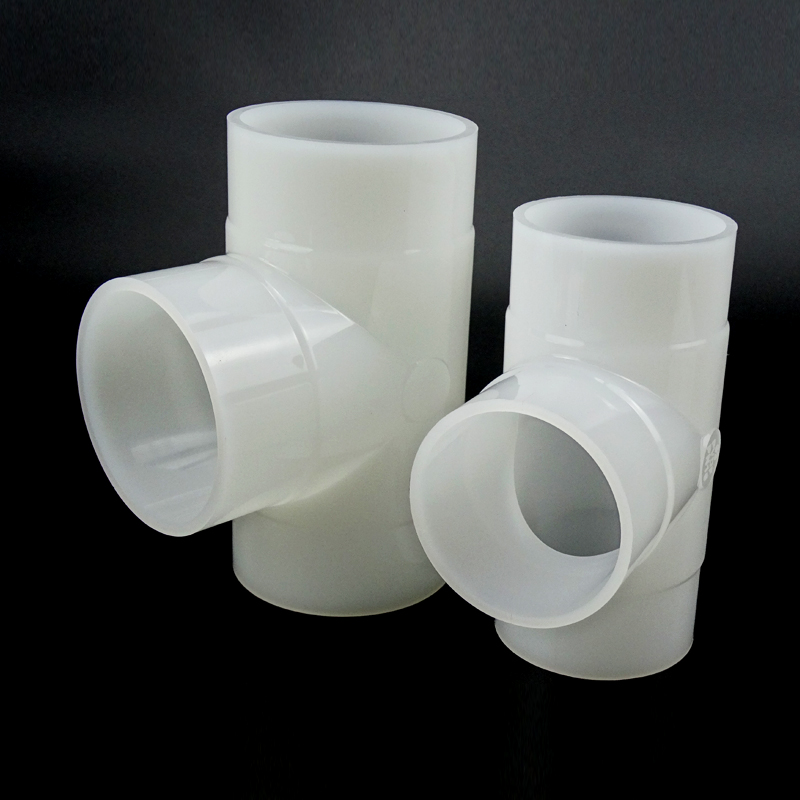
You must actively verify resin purity during the audit process. A reputable PVDF fittings manufacturer will strictly use 100% virgin PVDF resin. You should request proof of sourcing from major chemical companies. Avoid suppliers using regrind materials completely. Regrind resin compromises the chemical resistance of the final product. It also severely weakens mechanical strength. Virgin resin ensures consistent melt flow rates during installation.
Precision injection molding separates capable manufacturers from unreliable vendors. You must verify their molding capabilities thoroughly. Request their dimensional tolerance standards. Even minor ovality creates massive risks during welding. Wall-thickness variations cause uneven heating during socket fusion. High pressure stresses these chemical pipe fittings continuously. If the dimensions are inconsistent, the joint will eventually fail under stress.
Never accept technical claims without hard evidence. You should demand verifiable Quality Assurance and Quality Control (QA/QC) reports. The supplier must provide exact pressure rating certifications. These include specific SDR (Standard Dimension Ratio) or PN (Pressure Nominal) classes. Furthermore, you must request Material Test Reports (MTRs) for every batch. These documents prove compliance with industrial safety standards.
Many buyers accept generic certificates of conformity. You should always insist on lot-specific test reports. Generic certificates do not guarantee the quality of your specific batch.
Fittings require perfect calibration for installation. They must match specific joining methods exactly. A universal fitting does not exist in high-purity systems. You must ensure compatibility with your chosen installation technique. Common methods include Socket Fusion, Butt Welding, and Infrared (IR) Welding. IR welding demands the highest dimensional accuracy from the fitting.
A credible supplier does not just sell parts. They act as technical partners. They must provide exact welding parameters. You need precise temperature settings for their specific resin. They should supply detailed heating time charts. They must also define mandatory cooling phase matrices. Without these parameters, pipefitters are merely guessing.
Installation tooling matters just as much as the fitting. You should evaluate the supplier's tooling support. Do they offer compatible welding equipment rentals? Can they provide specific machine calibration data? Your installers need this data to fuse industrial PVDF fittings correctly. Seamless tooling integration reduces human error significantly.
PVDF Joining Methods Comparison Matrix
| Joining Method | Best Application | Dimensional Sensitivity | Equipment Required |
|---|---|---|---|
| Socket Fusion | Small diameter industrial lines | Moderate | Handheld heating tools |
| Butt Welding | Large diameter chemical lines | High | Hydraulic butt fusion machines |
| Infrared (IR) Welding | High-purity semiconductor lines | Very High | Automated IR welding equipment |
You must map the supplier's fulfillment infrastructure. Differentiate between brokers and actual manufacturers. Brokers often lack control over production schedules. Made-to-order manufacturers provide customization but risk long delays. The best partners maintain robust, localized warehousing. Localized stock buffers you against global shipping disruptions.
Raw material shortages impact the plastics industry frequently. How does the supplier handle these shortages? You must ask about their contingency planning. Request their historical on-time delivery (OTD) rates. A transparent supplier will share these metrics openly. They will also forecast potential delays proactively.
Project scopes often change rapidly. You need a supplier capable of scaling with you. Evaluate their ability to handle small-batch prototype orders. They must excel at urgent MRO (Maintenance, Repair, Operations) requests. Simultaneously, they must possess the capacity for full facility-build bulk orders. Flexibility in volume prevents supply bottlenecks during expansions.
Contractor errors cause most piping failures. You can prevent these errors through proper guidance. Check for the availability of comprehensive Standard Operating Procedures (SOPs). The supplier should provide detailed installation guides. These guides must include visual aids and troubleshooting steps. Clear SOPs protect your investment during the critical construction phase.
Even premium manufacturers occasionally produce defects. You must analyze their warranty structure before buying. Ask about their root-cause analysis (RCA) process. What happens if a fitting fails during hydrostatic testing? A reliable partner will dispatch engineering support immediately. They will conduct laboratory analysis to identify the exact failure mode.
Transitioning from metal to PVDF requires specialized knowledge. Welders accustomed to stainless steel often struggle with plastics. Does the supplier offer certification programs? Do they provide on-site or remote training for your pipefitters? Proper training mitigates installation risks drastically.
Require your installation contractors to complete the supplier's specific PVDF training program. Do this before they perform any welds on your actual production lines.
Start your evaluation with a rigorous Request for Information (RFI). Use this RFI to filter out unqualified vendors quickly. We recommend gathering the following baseline data:
Never place a bulk purchase order blindly. You must order initial sample batches first. Send these samples to your engineering team. Conduct destructive testing to verify mechanical strength. Measure them meticulously to verify dimensional consistency. This step validates the supplier's published specifications against reality.
Technical approval must align with commercial feasibility. You must establish clear commercial terms early. Align on Incoterms for shipping liabilities. Negotiate reasonable minimum order quantities (MOQs) for specialized parts. Finally, seek long-term price-lock agreements. Price locks protect your budget from resin market volatility.
Selecting a PVDF fittings partner is ultimately a risk-management exercise. You must balance technical precision with supply chain reliability. The cheapest unit price often carries the highest risk of systemic failure. A catastrophic leak will cost exponentially more than premium fittings.
We advise prioritizing transparent, technically proficient manufacturers over transactional vendors. Look for partners who offer comprehensive installation support and rigorous traceability. They should act as an extension of your engineering team.
Take action today to secure your piping network. Download a technical data sheet from your prospective supplier. Request a dedicated engineering consultation to review your schematics. Submit an RFQ with your specific application parameters to test their responsiveness and expertise.
A: High-purity PVDF fittings contain absolutely no pigmentation or additives. Manufacturers produce them in cleanroom environments to prevent contamination. The semiconductor industry relies on this purity. Standard industrial grades usually contain pigments. These pigments are often red or black. The pigment provides crucial UV resistance for outdoor chemical applications.
A: You must specify several critical details. First, provide the exact sizing standard (metric or imperial). Next, state the required pressure rating (PN or SDR). You must also identify the intended chemical media and the maximum operating temperature. Finally, specify your chosen joining method.
A: We strongly advise against mixing brands. While theoretically possible if dimensions match, it introduces severe technical risks. Different brands have variations in their melt flow index (MFI). This inconsistency compromises weld integrity. Furthermore, mixing brands almost always voids the system warranty from both manufacturers.
A: You should plan for realistic, conservative lead times. Expect standard bulk deliveries to take four to eight weeks. Highly specialized or large-diameter fittings may require several months. We emphasize the importance of choosing a supplier with domestic stocking programs. Local stock buffers you against long manufacturing delays.


