
close
Choose Your Site
Global
Social Media


Views: 0 Author: Site Editor Publish Time: 2026-05-19 Origin: Site


Handling hot corrosive media, ultra-pure water (UPW), or aggressive solvents creates severe failure risks for standard piping materials. When facilities rely on standard plastics in extreme conditions, the results often include catastrophic leaks, systemic contamination, or hazardous safety breaches. Specifying the wrong component ultimately leads to massive operational downtime and expensive emergency repairs. We introduce the PVDF ball valve as the premier solution for these harsh industrial environments. It perfectly bridges the gap between basic commodity plastics and prohibitively expensive exotic metal alloys. You no longer need to compromise between budget constraints and chemical safety. This guide provides engineers, procurement teams, and plant managers with a pragmatic, data-backed framework. You will learn how to accurately evaluate, specify, and integrate these resilient components into your most critical fluid handling systems. By the end, you will understand exactly why this material dominates high-purity and aggressive chemical applications.
Thermal & Chemical Limits: Capable of sustaining temperatures up to 140°C (284°F) while handling severe media like heated sulfuric acid and lithium battery electrolytes.
Purity & Compliance: Unpigmented, additive-free PVDF meets stringent SEMI F57, USP Class 6, and FDA requirements, ensuring zero leaching in pharmaceutical and sub-100nm semiconductor fabrication.
Lifecycle ROI: While initial capital expenditure is higher than PVC/CPVC, exceptional abrasion resistance (Taber loss of 5–10 mg/1000 cycles) and chemical stability drastically lower overall lifecycle costs.
Installation Integrity: True union designs and hermetically sealed socket fusion prevent tampering, fugitive emissions, and pipeline stress.
You must understand the underlying material science to appreciate this polymer's resilience. The extremely strong carbon-fluorine (C-F) bonds provide incredible long-term durability. PVDF consists of exactly 59% fluorine by weight. This unique chemical composition gives a high temperature plastic valve unmatched resistance against molecular degradation. It easily handles strong acids, aggressive halogens, and potent oxidants. You can safely push these materials to their absolute performance limits. Standard benchmark tests consistently demonstrate pressure ratings around 150 psi at 73°F under non-shock conditions. Beyond basic ambient temperatures, PVDF maintains deep structural integrity up to a maximum continuous operating limit of 140°C.
You also gain inherent fire safety benefits. The material features an impressive Limiting Oxygen Index (LOI) of 44%. This means it requires an atmosphere containing 44% oxygen to sustain a flame. Since normal air only contains 21% oxygen, the material self-extinguishes immediately. It confidently achieves the strict UL94 V-0 flame-retardant rating. Unlike softer fluoropolymers like pure PTFE, PVDF delivers substantial mechanical robustness. It withstands heavy physical impacts during routine maintenance. This structural strength prevents pipeline sagging between brackets. It significantly reduces the need for continuous exterior supports, saving substantial installation labor.
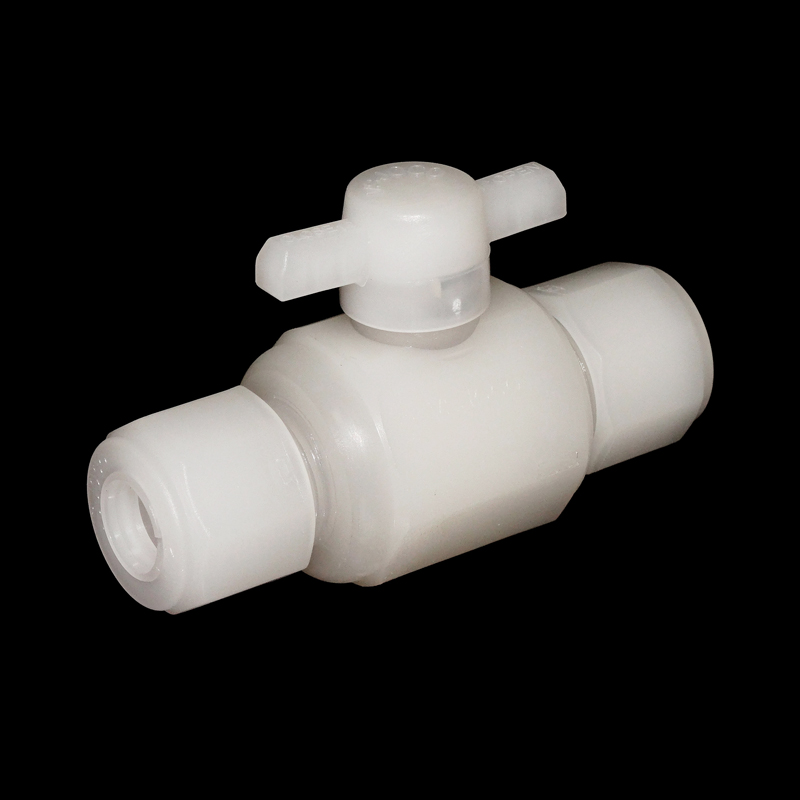
In maintenance-heavy production zones, you must specify True Union configurations. A PVDF industrial valve engineered this way saves countless maintenance hours. The design allows operators to unscrew two external lock nuts. You can then pull the central valve body directly out of the piping line. You never have to physically cut the surrounding pipeline. This simple architectural feature drastically cuts facility downtime during routine inspections.
Next, you must carefully consider the internal geometry. Zero dead-leg designs remain critical for high-purity environments. Fully welded or full-port ball structures prevent microscopic fluid entrapment. They actively stop dangerous biofilm formation. GMP-compliant pharmaceutical facilities demand this exact level of cleanliness. We also need to examine advanced internal sealing mechanisms. Superior designs feature bidirectional PTFE seats. They utilize dual O-ring stem seals for maximum external leak prevention.
You should actively look for proprietary safety innovations. Anti-loosening lock nuts combat the adverse effects of thermal cycling and heavy pipeline vibration. Safety break points on valve stems protect the core environmental seal. If extreme torque shears the handle off, the internal seal remains fully intact. This specific feature prevents catastrophic chemical spills during manual mishandling.
The PVDF socket welding ball valve serves as the absolute gold standard for ultra-pure applications. Installers use specialized thermostat-controlled heating tools for integration. They melt the internal polymer surfaces simultaneously. The parts are then forcefully joined. This physical process creates a homogenous, hermetically sealed joint. It becomes completely tamper-proof once cooled. You successfully eliminate all micro-gaps where bacteria or trace impurities might hide.
Sometimes, you must transition directly to metallic process lines or large chemical storage tanks. Flanged connections handle these structural transitions effectively. However, flanged joints introduce the serious risk of overtightening. Technicians must strictly adhere to specified cross-pattern torque limits. Many modern valves feature seat-stop micro-adjustments. These adjustments help neutralize axial force. They prevent external pipeline pressure from crushing the internal valve ball, ensuring smooth operation.
Modern sustainability protocols demand rigorous component traceability. Advanced manufacturers now integrate permanent data matrix codes directly onto the components. Some even embed RFID tags inside the physical valve handles. These digital features enable precise lifecycle tracking across massive processing plants. They help maintenance teams log exact installation dates and scheduled service intervals.
Centralized chemical processing eventually requires fully automated fluid components. Acid dosing, pH neutralization, and precise surface treatment facilities cannot rely on manual operations. You must eventually upgrade to pneumatic or electric actuated control systems. Evaluating actuator compatibility remains your first critical engineering step. PVDF bodies pair seamlessly with advanced industrial actuators.
You need to verify several essential specification criteria before purchase. Look closely for standard control loops.
Signal Integration: Match your 4-20mA or 0-10V control signals for precise flow modulation.
Environmental Protection: Demand an IP65 or higher enclosure rating. This prevents internal actuator corrosion in harsh chemical washdown areas.
Digital Feedback: Ensure the setup provides accurate PLC or SCADA position feedback. This confirms the actual valve status instantly on your control dashboard.
We must also plan rigorously for sudden power losses. Reliable automated processing requires built-in mechanical failsafes. Install pneumatic setups specifically configured to fail-closed or fail-open based on your site safety protocols. Always specify a manual override handwheel. This ensures field technicians can manually force the flow closed during catastrophic electrical failures.
Engineers often face immediate price objections during procurement. PVDF requires a noticeably higher initial capital investment than standard PVC or CPVC alternatives. However, you must evaluate the long-term operational return on investment. A resilient corrosive media valve drastically reduces premature material failure rates. You completely avoid the catastrophic expenses of unexpected facility downtime. You eliminate recurring labor costs for constant pipeline repairs.
Next, we must compare solid PVDF against traditional PTFE-lined steel pipes. Lined steel provides excellent chemical resistance internally. Unfortunately, the exterior steel shell remains highly vulnerable to corrosive ambient fumes inside the facility. Solid PVDF eliminates external corrosion risks entirely. It offers a lightweight, homogenous polymer structure throughout its entire body. You require far fewer structural pipe supports compared to heavy metal lines.
We can easily quantify this long-term durability using standardized industry data.
Material Type | Max Operating Temperature | Taber Abrasion Loss (mg/1000 cycles) | Exterior Corrosion Risk |
|---|---|---|---|
Solid PVDF | 140°C (284°F) | 5 - 10 mg | Zero |
Standard CPVC | 90°C (194°F) | > 20 mg | Zero |
PTFE-Lined Steel | 200°C+ | N/A (Internal Liner Only) | High (Steel Outer Shell) |
This comparison chart clearly highlights the massive performance gaps. PVDF posts an incredibly low Taber abrasion loss. It consistently outperforms softer industrial plastics by massive margins. These hard engineering facts move the procurement conversation past vague marketing claims. You ultimately secure verifiable, long-term mechanical reliability for the entire plant.
When selecting a chemical resistant PVDF valve, you must rigorously verify industry compliance. Look for an official NSF 61 certification for municipal drinking water applications. Verify FDA and USP Class 6 approvals for sensitive food and pharmaceutical lines. Semiconductor microelectronics require incredibly strict SEMI F57 compliance. These certifications guarantee the material contains zero plasticizers, zero stabilizers, and zero colored pigments.
We must next address a very common field panic: high-temperature polymer discoloration. Unpigmented high-purity piping sometimes turns visibly brown or black after several months. This visual shift frequently occurs in ultra-pure water (UPW) systems running consistently between 70°C and 80°C. Plant managers immediately assume the polymer is dangerously degrading. They worry about microscopic particles shedding into the fluid stream.
We must clarify the underlying chemical reality. This discoloration represents a purely cosmetic effect. It results from minor carbon double-bonding rearranging within the core polymer chain. It does not indicate structural failure or material breakdown. Analytical laboratory models thoroughly prove this safety profile. Even in heavily discolored piping systems, extractable fluoride levels remain well below standard detection limits. They register under 0.019 parts per trillion (ppt). This guarantees absolute total system safety for even the most sensitive sub-100nm silicon wafer fabrication.
You can confidently rely on these advanced polymers for extreme industrial applications. Prioritize PVDF immediately when handling aggressive halogens, strong boiling acids, or complex solvent mixtures. It remains your absolute best engineering option when operating fluid systems continuously above 90°C. It serves as the ultimate choice for critical processing applications demanding absolute zero-leaching purity.
Verify Media Concentration: Always cross-reference your exact chemical concentrations against verified material resistance charts before finalizing any purchases.
Calculate Flow Requirements: Determine the precise Kv/Cv flow values needed to maintain optimal system pressure without causing destructive water hammer.
Select Connection Standards: Choose thermal socket fusion for absolute biological purity or flanged connections for transitioning to legacy metallic tanks.
Request Vendor Specifications: Ask manufacturers directly for documented pressure-temperature derating curves tailored to your specific ambient operating environment.
Follow these concrete steps to secure a highly resilient, leak-free industrial processing system for your facility.
A: Valve pressure ratings share a strict inverse relationship with operational temperature. Most standard industrial models carry a baseline rating of 150 to 232 psi at ambient room temperature (73°F). However, you must carefully apply manufacturer derating curves as the internal fluid heats up. When approaching the maximum continuous limit near 140°C, the allowable working pressure drops significantly to ensure absolute structural safety.
A: Yes, you can confidently install them outdoors in exposed environments. The unique carbon-fluorine molecular structure makes the base material inherently resistant to UV radiation and harsh ambient weathering. Unlike standard PVC or polypropylene pipes, it does not require added chemical UV stabilizers or protective external paint coatings to prevent long-term sunlight embrittlement.
A: Fluoropolymers require highly complex, extremely energy-intensive manufacturing processes. The raw material boasts incredibly strong carbon-fluorine bonds, providing unmatched resistance to harsh chemicals and high heat. While the initial component purchase price remains higher, the investment yields significant long-term financial savings through eliminated field maintenance, drastically reduced facility downtime, and an exceptionally long operational lifespan.


