
close
Choose Your Site
Global
Social Media


Views: 0 Author: Site Editor Publish Time: 2026-05-22 Origin: Site


In critical fluid handling operations, tubing failure does much more than halt production schedules. It leads to catastrophic batch loss, severe cross-contamination, and dangerous workplace safety hazards. Engineers simply cannot afford material compromises when transferring volatile chemicals or highly sensitive biological media. Choosing the right piping requires moving far beyond generic labels. You must rigorously evaluate thermal cycling limits, extractable profiles, and stringent compliance standards. Selecting between standard options means understanding the strict nuances of SEMI F-57 and USP Class VI certifications. Making the wrong choice risks both product integrity and facility safety.
This guide deconstructs the physical properties and application limits of advanced fluoropolymers. We explore the detailed shortlisting logic engineers use to specify these materials in zero-compromise environments. You will learn how to balance thermal demands, pressure ratings, and purity requirements effectively. Our engineering insights will help you optimize your next critical system build.
Thermal & Mechanical Boundaries: PFA handles extreme heat (up to 260°C/500°F) and repeated thermal cycling, while FEP excels in applications requiring maximum optical clarity up to 204°C (400°F).
Purity & Compliance: High-purity PFA is the definitive standard for trace-metal-free semiconductor transfer; FEP is uniquely suited for precise pharmaceutical dosing due to low sorption and deformation.
Risk Mitigation: Advanced dual-containment configurations (PFA inner, FEP outer) provide necessary redundancy for aggressive chemical transport.
Engineering Margins: Working pressure should strictly follow temperature-adjusted burst pressure formulas (typically 1/6 for liquids, 1/4 for gases).
Generic plastics or lower-grade fluoropolymers routinely introduce organic and metallic leachables. This chemical off-gassing heavily compromises sensitive analytical and biological processes. Operators often discover these invisible contaminants far too late. When managing high purity fluid transfer, precision remains strictly non-negotiable. Substandard materials break down silently under harsh chemical stress. They shed dangerous micro-particles directly into the main fluid stream.
Bioprocessing presents extremely unique sorption and deformation risks. Many standard polymer lines absorb active pharmaceutical ingredients (APIs) directly into their inner walls. This material absorption chemically alters the intended fluid concentration. Furthermore, piping often deforms under intense peristaltic pumping pressure. Such physical deformation alters the internal diameter permanently. It heavily reduces your final-fill dosing accuracy during packaging.
Melt-processable fluoropolymers offer a definitive engineering solution to these issues. Both Perfluoroalkoxy (PFA) and Fluorinated Ethylene Propylene (FEP) undergo advanced melt-extrusion. Manufacturers produce them in extremely long continuous lengths. This continuous process eliminates the need for high-risk manual splicing. Traditional paste-extruded PTFE requires frequent mechanical joints. Those joints create dangerous dead-legs where bacteria and particles inevitably accumulate.
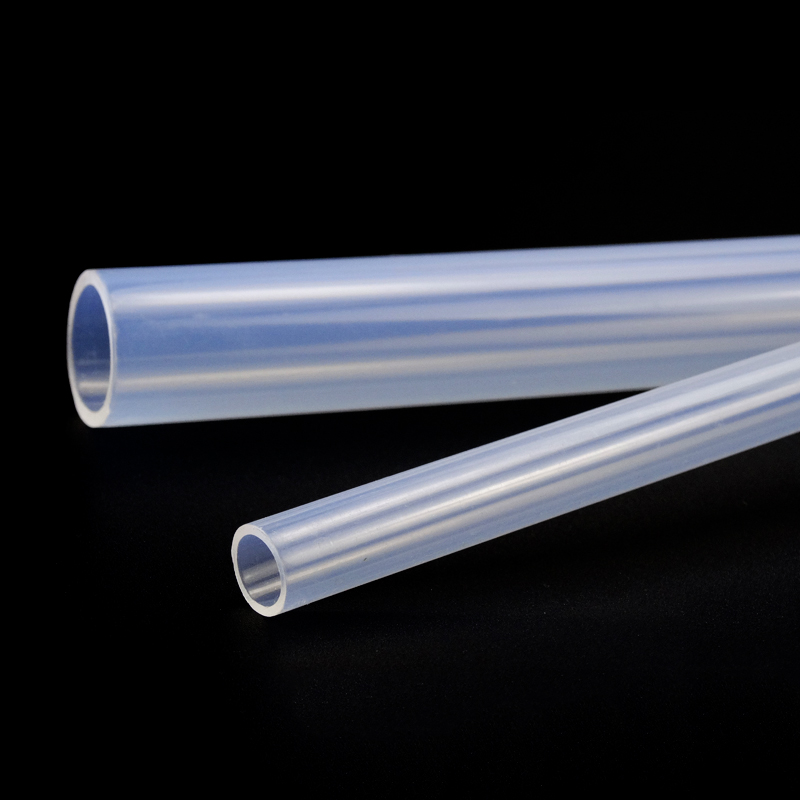
Both materials share distinct and highly advantageous molecular similarities. They offer near-universal chemical inertness and exceptional dielectric strength. They exhibit incredibly low surface friction coefficients. Their chemical formulations remain completely free of industrial plasticizers. They contain absolutely no animal-derived ingredients, ensuring strict BSE/TSE-free regulatory compliance.
Here is a closer look at the standard FEP profile:
It operates as a true co-polymer of TFE and HFP monomers.
It provides exceptional optical clarity and excellent UV transmission capabilities.
It possesses a slightly lower tensile strength of approximately 4000 psi.
It carries a moderate thermal ceiling compared to stronger high-heat alternatives.
Conversely, the standard PFA profile offers distinct heavy-duty advantages:
Engineers designed it to match PTFE's thermal and chemical performance exactly.
It maintains excellent melt-processability for seamless long-run factory extrusions.
It delivers a consistently higher tensile strength of roughly 4200 psi.
It features a remarkably smoother internal surface finish for flow control.
It shows superior resistance to stress-cracking under prolonged industrial heat.
Specifying a PFA FEP tube requires balancing these baseline attributes carefully. You must weigh the structural toughness of one against the optical clarity of the other. We recommend evaluating your specific environmental stressors before deciding.
Aggressive manufacturing environments demand truly uncompromising thermal stability. A standard PFA tube handles continuous service at 260°C (500°F) easily. It comfortably withstands active saturated steam up to 4.5 bar gauge. This intense thermal resilience prevents catastrophic material softening during flash-heating cycles. You rarely see heat-induced ruptures when applying this polymer correctly.
Semiconductor and ultra-high purity (UHP) manufacturing facilities rely heavily on these specific polymers. High-purity grades compliant with strict SEMI F-57 standards are entirely mandatory here. They safely handle ultra-pure water (UPW) and abrasive CMP slurries daily. They transport highly corrosive etchants like hydrofluoric and hot sulfuric acids. They achieve this chemical transport without introducing any microscopic particulate defects into the line.
Extreme chemical processing often requires robust high-barrier technology upgrades. Standard walls occasionally allow micro-permeation of aggressive agents over time. Manufacturers frequently upgrade standard lines into specialized high-barrier formulations. These advanced variants significantly suppress the permeation of aggressive agents like hydrochloric acid. They protect surrounding sensitive equipment and personnel from invisible corrosive gas leaks.
Medical and biological applications demand absolute biocompatibility and rigorous sterilization validation. A standard FEP tube meets strict FDA and USP Class VI standards perfectly. Facilities repeatedly sterilize these lines without degrading their mechanical integrity whatsoever. They comfortably survive repeated autoclave runs, intense gamma irradiation, and Ethylene Oxide (EtO) treatments.
Automated sterile filling processes require highly precise volumetric control. FEP provides highly specific structural rigidity under controlled cleanroom environments. This exact rigidity minimizes line expansion during active peristaltic pumping cycles. Less expansion ensures unparalleled precision in automated sterile dispensing systems. You achieve reliable, repeatable fluid dosing for highly sensitive liquid medications.
Furthermore, maximum transparency provides distinct visual inspection advantages during manufacturing. Operators easily monitor active fluid flow in real-time. They quickly detect dangerous microscopic air bubbles before they reach final packaging. They confidently verify internal cleaning processes visually. This clarity proves essential when transporting costly vaccine batches and delicate cell culture media. It functions perfectly as pharmaceutical transfer tubing in high-stakes clinical environments.
Transporting hazardous materials often requires multiple structural fail-safes. Standard single-wall chemical resistant tubing might not suffice for highly toxic chemicals. Extreme environments demand layered redundancy to protect human operators and expensive machinery nearby.
Engineers frequently implement advanced dual containment architectures to mitigate extreme risks. They utilize a UHP PFA inner layer for pure, inert fluid contact. They jacket this inner core securely inside a highly durable FEP outer layer. This specific structure provides a transparent, highly resilient containment barrier. It catches potential inner leaks instantly while allowing fast visual identification.
Melt-processing naturally allows for immense profile adaptability during production. Facilities often require specific custom morphologies far beyond simple round shapes. Manufacturers produce lay-flat profiles to save critical spatial footprint. They extrude complex multi-lumen profiles for highly delicate catheter applications. They also create specialized heat-shrink configurations routinely. These custom shapes encapsulate delicate analytical equipment and sensitive electronic sensors perfectly.
Selecting the right material requires a strict logical framework. You must navigate temperature constraints, absolute purity demands, and strict capital project limits. We recommend following a structured analytical approach to prevent engineering over-specification.
Analyze Temperature vs. Budget Trade-offs: Establish your maximum continuous operating temperature first. If temperatures exceed 200°C (392°F) or involve aggressive thermal cycling, PFA remains the only viable choice. For sub-200°C applications requiring high line visibility and strict initial capital control, specify FEP instead.
Calculate Strict Safety Margins: Never operate any polymer system at its stated room-temperature burst pressure. You must implement specific temperature correction factors rigorously. Apply strict safety ratios routinely during system design. Calculate your maximum operating pressure at roughly 16% (1/6) of the burst pressure for liquids. Use 25% (1/4) of the burst pressure for compressed gases.
Assess Critical Purity Requirements: Both baseline materials meet standard FDA and USP compliance easily. However, processes demanding ultra-low extractables require careful material upgrades. Sub-7nm semiconductor nodes or highly sensitive laboratory mass spectrometry systems absolutely require verified UHP PFA grades.
We have compiled a baseline reference chart to simplify your initial evaluation. Use this specific matrix to compare core performance ceilings quickly.
Performance Metric | Standard FEP | Standard PFA |
|---|---|---|
Max Continuous Temperature | 204°C (400°F) | 260°C (500°F) |
Tensile Strength | ~4,000 psi | ~4,200 psi |
Optical Clarity | Exceptional / Transparent | Good / Translucent |
Flex Life & Stress Cracking | Moderate | Excellent |
Common Industry Standard | USP Class VI | SEMI F-57 (UHP Grades) |
Specifying advanced fluoropolymer piping is a highly strategic engineering decision. It requires balancing thermal limits, stringent purity demands, and overarching operational safety. Over-specifying simply drives up your initial capital equipment costs unnecessarily. Conversely, under-specifying invites catastrophic system failure and severe chemical hazard exposure.
Here are the critical takeaways to guide your final specification process:
Reserve PFA strictly for extreme thermal loads and highly aggressive chemical processing environments.
Deploy FEP when you need maximum optical clarity and precise volumetric dosing validation.
Always calculate safe working pressures using strict ratios for both process liquids and gases.
Utilize dual-containment architectures when transporting highly toxic or environmentally dangerous materials.
Take direct action by validating your application's continuous operating temperature and chemical exposure limits today. Request comprehensive material validation guides and compliance certificates from your manufacturing partner immediately. Ask for physical material samples to conduct rigorous in-house pressure and immersion testing before initiating your final system scale-up.
A: While PTFE has excellent chemical and thermal resistance, it is paste-extruded, which results in a micro-porous structure and limited continuous lengths. PFA and FEP are melt-extruded, yielding significantly smoother, less porous inner walls (reducing contamination risk), much longer continuous lengths, and better transparency.
A: FEP is highly resilient but is not recommended for sustained extreme high-pressure operations. For applications requiring both high pressure and chemical inertness, reinforced PFA, specialized high-barrier formulations, or stainless-steel braided variants are required.
A: Both PFA and FEP withstand common sterilization methods. PFA exhibits superior resistance to metal fatigue and stress cracking over hundreds of extreme heating/cooling cycles (like repeated autoclaving), making it a longer-lasting investment for heavy-duty reusable assemblies.


