
close
Choose Your Site
Global
Social Media


Views: 0 Author: Site Editor Publish Time: 2026-05-26 Origin: Site


Operational stakes at the wet bench are incredibly high. Sub-micron contamination can ruin entire production batches. Chemical cross-contamination easily causes devastating yield losses. These risks plague both semiconductor fabrication and photovoltaic (PV) manufacturing. You cannot afford simple errors in these delicate environments.
Standard fluid handling equipment often fails in ultra-pure settings. Metal components suffer rapid corrosion. Lower-grade plastics shed particles into your chemical streams. Poorly designed valves promote aggressive bacterial buildup. Standard seals degrade and release contaminants directly onto your substrates. Facility managers and process engineers need superior alternatives. You must evaluate fluid dynamics, structural integrity, and material purity.
This technical guide will help you select the ideal PTFE rinsing gun for your facility. We will explore the critical chemistry of pure water. You will learn about modern hygienic designs. We will also detail specific application requirements. By following these principles, you can secure your process environments against hidden contamination risks.
Material Necessity: Ultra-pure DI water causes "ion starvation" in metal components; virgin PTFE and PFA are mandatory for wetted parts to prevent ion leaching.
Design Imperatives: Modern hygienic designs eliminate O-rings and internal dead space to prevent bacterial accumulation and particle trapping.
Application Specifics: Evaluating nitrogen versus liquid delivery requires different structural validations (e.g., trigger-leak prevention for N2 vs. recirculating paths for DI water).
Contamination control begins at the molecular level. Cleanrooms utilize highly refined fluids. These fluids interact aggressively with their surrounding environments. You must understand these chemical behaviors. This knowledge ensures proper equipment selection.
High-purity deionized (DI) water behaves uniquely. The purification process strips all ions from the water. It removes sodium, calcium, and iron. This leaves the water structurally "hungry." It actively seeks replacement ions to achieve balance. We call this phenomenon "ion starvation."
When DI water touches metallic surfaces, it aggressively draws ions out. This causes rapid, catastrophic metal corrosion. Metal ions then enter your fluid stream. They ruin your silicon wafers. You must prevent this interaction entirely. A dedicated deionized water spray gun relies on pure fluoropolymers. Virgin PTFE provides a non-conductive, non-leaching barrier. It is the only viable long-term solution. PTFE ignores the ion demand. It keeps your DI water pristine.
Wet processing involves highly aggressive chemistries. You frequently use Hydrofluoric acid (HF). You employ Piranha etch mixtures. RCA cleaning steps require harsh solvents. Standard plastics quickly degrade here. They swell, crack, or dissolve.
PTFE exhibits extraordinary chemical inertness. Carbon-fluorine bonds are incredibly strong. They resist chemical attacks from virtually all industrial acids. PTFE does not degrade over time. It never sheds sub-micron particles into the chemical stream. This protects your delicate microstructures from physical defects.
Temperature variations add significant stress to fluid systems. Many cleaning protocols require elevated fluid temperatures. Hot DI water improves particulate removal efficiency. It accelerates chemical reactions during wafer surface preparation.
Your handling equipment must maintain structural integrity. Operational temperature requirements often reach up to 93°C (200°F). Lower-grade materials warp at these extremes. PTFE maintains its dimensional stability. It handles thermal cycling without compromising internal seals. This ensures consistent operator safety and predictable fluid delivery.
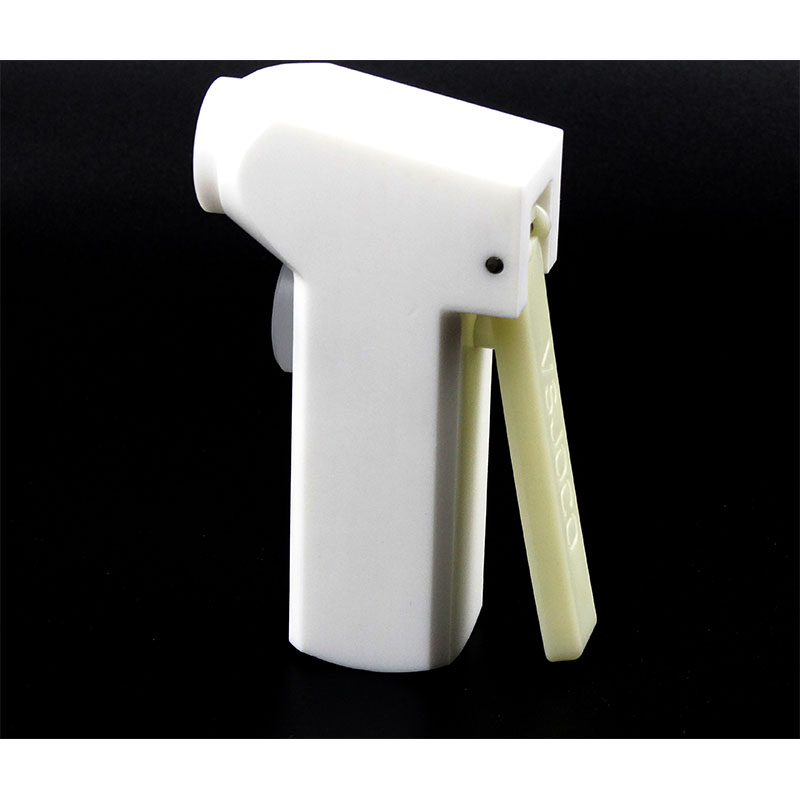
Procuring a reliable semiconductor cleaning gun requires rigorous technical evaluation. You cannot rely on visual appearance alone. You must inspect internal engineering choices. These mechanics dictate long-term performance.
Actuation mechanisms usually require metal components. Springs provide the necessary tension for triggers. However, metal must never touch your process fluids. Total media isolation is absolutely mandatory.
Engineers achieve this using precision-machined diaphragms. These barriers separate the mechanical chamber from the fluid path. The fluid only contacts virgin fluoropolymer surfaces. If a spring degrades, the debris stays isolated. It never reaches your critical process environment.
Internal geometry dictates hygiene. Traditional valve designs create sharp internal corners. Fluid stagnates in these areas. We call these areas "dead space." Bacteria flourish in stagnant pure water. They form biofilms. These biofilms release massive particulate loads over time.
Modern equipment advocates for seal-less engineering. You should avoid standard O-rings. O-rings degrade and harbor bacteria. Precision-machined internal chambers smooth out flow paths. They leave zero room for fluid entrapment. This design effectively suppresses bacterial multiplication.
Cleanroom fluid networks operate under continuous pressure. Your dispensing tools must safely match these system dynamics. Establish strict industry baselines for your procurement.
Identify the maximum line pressure in your facility.
Select equipment exceeding those parameters.
Ensure consistent flow rates during prolonged actuation.
Verify factory testing protocols for burst resistance.
A properly engineered chemical resistant rinsing gun tolerates substantial force. It should safely handle 75 to 80 psig maximum pressure. This rating ensures safe, reliable operation across diverse wet bench configurations.
Upstream filters capture most bulk contaminants. However, piping networks still generate micro-particles. Point-of-use filtration offers the final line of defense. Built-in filtration units capture rogue particulates.
Look for integrated 0.5 µm PTFE membrane filters. These elements sit right before the dispensing nozzle. They catch anything dislodged within the hose. They guarantee ultimate purity just before the fluid reaches the solar cell.
Different media require fundamentally different valve architectures. Gases behave differently than liquids. You must align the internal engineering with the specific medium. A universal approach often results in systemic failures.
Stagnant water remains your biggest bacterial threat. A standard dead-end hose allows water to sit idle. Recirculating systems solve this structural flaw. They maintain continuous fluid movement.
In these specialized designs, pure water flows constantly. It travels down the supply line. It enters the gun body. It circulates right up to the sealing seat. Then, it returns through a separate line. The water never stops moving. This continuous flushing denies bacteria the stagnant conditions they need.
Nitrogen blow-off presents unique challenges. Gas molecules easily escape microscopic gaps. Traditional push-buttons struggle to contain pressurized gas. They develop severe leaks over time.
When selecting a nitrogen spray gun, inspect the valve design. You must demand specific anti-leak architectures. Advanced designs use specialized poppet valves. These mechanisms utilize the gas pressure to strengthen the seal. The harder the nitrogen pushes, the tighter the seal becomes. This completely eliminates disruptive gas leakage.
Spray patterns drastically affect process results. A harsh stream can shatter delicate silicon structures. A wide fan might splash dangerous acids onto operators. Interchangeable nozzles provide necessary flexibility.
Threaded connections allow quick nozzle swaps. You can attach anti-splash elongated nozzles. These are perfect for careful acid dispensing. You can insert them directly into chemical baths. This prevents dangerous fluid rebound. Other processes require misting nozzles. You can tailor the exact delivery method to the substrate.
The following chart summarizes the distinct engineering focus required for liquid versus gas applications.
Application Focus | Liquid Delivery (DI Water/Acids) | Gas Delivery (Nitrogen Blow-Off) |
|---|---|---|
Primary Threat | Bacterial buildup & ion starvation | Microscopic gas leaks & pressure loss |
Valve Architecture | Recirculating paths to prevent stagnation | Anti-leak poppet valves |
Nozzle Requirement | Anti-splash, elongated dispensing | High-velocity focused streams |
Filtration Need | Particulate & organic capture | Sub-micron membrane (0.5 µm) |
The dispenser represents only half the system. The delivery hose holds equal importance. An excellent dispenser attached to a degrading hose guarantees contamination. You must curate a complete fluoropolymer ecology.
Different polymers offer distinct advantages. You must balance flexibility, temperature resistance, and extractable levels. Using the wrong tubing material introduces severe risks.
Material Type | Physical Characteristics | Best Use Case | Limitations |
|---|---|---|---|
PU (Polyurethane) | Coiled, highly flexible | Mild pure water at room temperature | Not suitable for harsh acids or high heat |
FEP | Coiled, softer than PTFE | General chemical handling, elevated temps | Lower tensile strength than PFA |
PFA | Coiled, ultra-low extractables | High-purity semiconductor lines | Higher rigidity than PU |
PTFE | Straight tubing, rigid | Maximum chemical/temperature resistance | Cannot be effectively coiled |
Consider your specific process parameters. FEP offers excellent transparency. PFA delivers superior surface smoothness. This smoothness prevents micro-particle adherence. PTFE provides the ultimate chemical barrier. Match the polymer to your specific wet bench demands.
Procurement involves stringent logistics. A pure PTFE spray gun loses all value if contaminated during transit. Manufacturing residues easily compromise cleanroom environments. You must verify factory packaging standards.
Reputable manufacturers follow strict protocols. They perform intensive DI water washes. They dry components using ultra-pure nitrogen. They assemble everything inside certified cleanrooms. Finally, they double-bag the items in 4-mil cleanroom plastic. This ensures the equipment arrives pristine. Your operators can wipe down the outer bag in the gowning room. They bring the sterile inner bag directly to the wet bench.
Specifying fluid handling accessories is a critical yield-protection measure. It is never a generic hardware purchase. Your wet bench operations demand flawless material performance. Sub-micron contamination destroys profitability. You must prioritize absolute material purity.
Advise your procurement teams to audit current facility pain points. Look closely at bacterial growth in DI lines. Identify persistent N2 leaks. Note operator fatigue during long shifts. Select vendors offering verified pressure ratings. Demand totally isolated fluid paths. Insist on virgin PTFE and PFA wetted parts.
Take immediate action to secure your processes. Encourage process engineers to request detailed technical data sheets. Review chemical compatibility matrices thoroughly. Request sample units for pilot testing. Evaluate these devices in your specific wet bench environment before full deployment. Rigorous testing prevents future production disasters.
A: High-quality devices are typically engineered for 75 to 80 psig. This robust pressure rating ensures safe, reliable operation across diverse pressurized cleanroom fluid systems without risking structural failure or operator injury.
A: PVDF offers excellent mechanical strength. It minimizes internal friction and wear during actuation. Furthermore, PVDF is highly resistant to bacterial growth. It perfectly complements the supreme chemical inertness of the main PTFE body.
A: They eliminate internal "dead legs." The design maintains a continuous flow of DI water through the chamber right up to the sealing seat. This constant flushing denies bacteria the stagnant fluid conditions they need to multiply.
A: Yes. High-grade PTFE and PFA assemblies can easily handle extreme fluid temperatures. Depending on the specific valve and seal design, they typically operate safely in ranges from -17°C to 93°C.


