
close
Choose Your Site
Global
Social Media


Views: 88 Author: Site Editor Publish Time: 2026-06-06 Origin: Site


A PFA Spring Tube is a coiled fluoropolymer tube designed for clean, flexible, and chemically resistant fluid transfer in demanding process environments. In pharmaceutical and biotech systems, tubing must handle purified water, reagents, buffers, solvents, cleaning agents, and sensitive process liquids without creating contamination risk or reacting with the fluid path. Because a PFA Spring Tube combines PFA material stability with a spring-shaped structure, it is widely used where compact installation, repeated movement, high-purity contact, and reliable fluid routing are required.
● PFA Spring Tube is used for clean and flexible fluid transfer.
● PFA Spring Tube provides strong chemical resistance for pharmaceutical and biotech fluids.
● PFA Spring Tube supports compact routing in limited equipment spaces.
● PFA Spring Tube reduces excessive loose tubing around instruments and process units.
● PFA Spring Tube is suitable for high-purity liquid handling when properly specified.
● PFA Spring Tube should be selected based on fluid type, temperature, pressure, size, coil design, and connection method.
A PFA Spring Tube is a spring-shaped tube made from perfluoroalkoxy, a high-performance fluoropolymer known for chemical inertness and thermal stability. Unlike ordinary straight tubing, a PFA Spring Tube is formed into a coiled structure that can extend and retract during operation. This structure makes the PFA Spring Tube suitable for fluid systems that need movement tolerance without sacrificing clean contact performance.
Standard PFA tubing is commonly used in straight or gently curved fluid lines, while a PFA Spring Tube is engineered for flexible movement and space-saving installation. The spring shape allows the tube to absorb extension, repositioning, and equipment adjustment more effectively than a loose straight tube. A PFA Spring Tube keeps the chemical and high-purity advantages of PFA while adding better practical handling in dynamic fluid transfer layouts.
The spring structure of a PFA Spring Tube reduces the need for long unsupported tubing sections around pumps, containers, valves, and analytical instruments. When operators connect or reposition equipment, the PFA Spring Tube can stretch and recover, reducing pulling stress on fittings. In pharmaceutical and biotech fluid transfer, stable routing from a PFA Spring Tube can reduce kinking risk, improve workspace organization, and maintain more controlled fluid movement.
Pharmaceutical fluid transfer often involves purified water, alcohols, acids, alkalis, solvents, and cleaning chemicals that can attack ordinary polymer tubing. A PFA Spring Tube resists many aggressive media under suitable operating conditions, making it valuable for process lines and cleaning cycles. This resistance allows the PFA Spring Tube to maintain a stable fluid path where chemical compatibility is a major requirement.
Pharmaceutical systems require tubing materials that do not contribute unwanted substances into sensitive fluids. A PFA Spring Tube has a low-extractable profile compared with many general-purpose plastic tubes, which makes it suitable for high-purity transfer applications. When specified correctly, a PFA Spring Tube can reduce material-related contamination concerns in purified water, reagent transfer, and formulation support lines.
Temperature variation is common in pharmaceutical production, especially during heated transfer, rinsing, cleaning, and controlled process steps. A PFA Spring Tube offers strong thermal stability and maintains its properties across a broad temperature range. This allows the PFA Spring Tube to remain dimensionally stable where heat, chemicals, and repeated operating cycles occur together.
Pharmaceutical equipment often contains pumps, filling heads, dosing stations, sampling points, and compact fluid manifolds. A PFA Spring Tube can be installed in these areas without leaving excessive slack or uncontrolled loops. Cleaner routing with a PFA Spring Tube supports more orderly installation, easier inspection, and more predictable handling during operation.
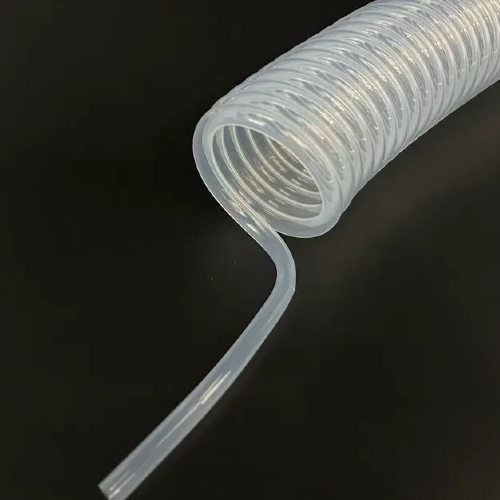
Biotech systems may transfer buffers, reagents, culture-related liquids, enzymes, and other sensitive fluids that require stable contact materials. A PFA Spring Tube provides a non-reactive fluoropolymer pathway that limits unwanted interaction between the tube wall and the fluid. This makes the PFA Spring Tube useful where process consistency and fluid integrity must be maintained.
Biotech instruments, laboratory systems, and process skids often place multiple fluid paths inside limited installation spaces. A PFA Spring Tube can extend and retract between fixed and movable points, making it suitable for compact equipment layouts. The coiled structure of a PFA Spring Tube reduces messy tubing arrangements while preserving flexibility for operation and maintenance.
The inner surface of a PFA Spring Tube is smooth and chemically stable, which can reduce the tendency of residues to adhere to the tubing wall. This is important in biotech applications involving buffers, cleaning fluids, and process liquids that require controlled fluid contact. A cleaner inner surface in a PFA Spring Tube can support more effective flushing between transfer steps.
Biotech systems often require repeated sampling, container changes, reagent replacement, or instrument adjustment. A PFA Spring Tube tolerates this movement better than rigid or poorly routed tubing because the spring form distributes extension more evenly. When used within its design range, the PFA Spring Tube can reduce strain on connection points and improve long-term handling reliability.
Chemical inertness is one of the primary reasons a PFA Spring Tube is selected for pharmaceutical and biotech fluid systems. The PFA material resists reaction with many acids, bases, solvents, oxidizers, and cleaning agents under appropriate conditions. This stability allows the PFA Spring Tube to serve as a reliable fluid path where chemical attack would compromise ordinary tubing.
The coiled structure gives a PFA Spring Tube better extension and recovery behavior than a straight tube installed with excess length. It can stretch during connection or equipment movement and then return toward its original form after the movement stops. This flexibility makes the PFA Spring Tube practical for movable process points, compact benches, dosing systems, and laboratory equipment.
A PFA Spring Tube is suitable for many high-purity applications because PFA has low surface reactivity and strong material stability. In pharmaceutical and biotech fluid transfer, purity requirements often demand tubing that does not easily leach contaminants or absorb process materials. The high-purity compatibility of a PFA Spring Tube makes it appropriate for carefully controlled liquid paths.
Repeated movement, cleaning, connection, and disconnection can weaken ordinary tubing over time. A PFA Spring Tube is designed to handle dynamic use more effectively because its coiled shape distributes movement along the tube body. In properly designed systems, the PFA Spring Tube can reduce premature replacement caused by bending stress, handling strain, or installation fatigue.
Performance Requirement | PFA Spring Tube Performance | Relevance to Pharma and Biotech Fluid Transfer |
Chemical resistance | Resists many acids, solvents, alkalis, and cleaning agents | Suitable for process fluids and cleaning cycles |
High-purity contact | Low extractables and low surface reactivity | Supports purified water, reagents, and sensitive liquids |
Flexible movement | Spring shape allows extension and recovery | Useful around movable equipment and compact systems |
Temperature stability | Maintains performance across demanding thermal conditions | Suitable for heated transfer and repeated cleaning |
Compact routing | Reduces excessive loose tubing | Improves organization around instruments and skids |
Handling durability | Tolerates repeated movement within design limits | Reduces stress on fittings and connection points |
A PFA Spring Tube can be used for purified water and reagent transfer where clean contact and chemical stability are required. These systems often demand tubing that does not easily react with the liquid or release unwanted materials into the stream. The coiled form of a PFA Spring Tube also makes it easier to route lines around containers, instruments, and controlled transfer points.
Sampling lines often require tubing that can move between vessels, probes, analytical instruments, and collection containers. A PFA Spring Tube supports flexible movement while reducing excessive loose tubing around work areas. In analytical fluid handling, the stable surface of a PFA Spring Tube can contribute to more consistent sample transfer conditions.
Filling and dosing systems require tubing that can handle repeated movement, controlled fluid delivery, and frequent cleaning. A PFA Spring Tube is suitable for these environments because it combines flexibility with chemical and thermal resistance. When installed correctly, the PFA Spring Tube can reduce stress near filling heads, dosing nozzles, and movable process connections.
Cleaning and flushing lines may expose tubing to heated liquids, chemical detergents, acids, alkalis, or solvents. A PFA Spring Tube can withstand many of these conditions when the fluid, concentration, temperature, and exposure time are within the material’s service range. This makes the PFA Spring Tube useful in systems where tubing must remain stable through repeated cleaning procedures.

A PFA Spring Tube should not be stretched beyond its practical working range during installation or operation. Overstretching can place excessive tension on the tube body and connected fittings. Maintaining a suitable extension range allows the PFA Spring Tube to recover properly and preserve long-term routing performance.
Although a PFA Spring Tube is flexible, it still requires proper routing to avoid sharp bends and concentrated stress points. Tight bends near fittings can create localized strain and may reduce the reliability of the fluid connection. A well-routed PFA Spring Tube maintains smoother flow and more stable mechanical performance.
Pharmaceutical and biotech systems often require regular inspection, flushing, cleaning, or replacement of tubing sections. A PFA Spring Tube should be installed where operators can inspect its condition, connection points, and routing path. Easy access to the PFA Spring Tube supports controlled maintenance and reduces the chance of unnoticed wear or contamination risk.
A PFA Spring Tube is used in pharmaceutical and biotech fluid transfer because it combines chemical resistance, high-purity compatibility, temperature stability, flexible movement, and compact routing. Its spring-shaped structure makes it especially practical for systems involving repeated handling, movable equipment, sampling lines, filling stations, dosing units, and controlled liquid transfer paths. For projects requiring PFA Spring Tube selection, fluoropolymer tubing, or compatible pipeline connection components, VSJOCO Zixing Yuguang Pipeline System Co., Ltd. provides practical solutions for demanding pharmaceutical and biotech fluid handling applications.
A PFA Spring Tube is used for flexible, clean, and chemically resistant fluid transfer in pharmaceutical, biotech, laboratory, and high-purity process systems. It is suitable for purified water, reagents, buffers, selected solvents, and cleaning fluids when compatibility requirements are met. The spring form of a PFA Spring Tube makes it useful where compact routing and repeated movement are required.
A PFA Spring Tube is suitable for pharmaceutical systems because it offers chemical inertness, low extractables, and strong temperature stability. These properties are important for purified liquids, formulation support, cleaning procedures, and controlled process fluid paths. A properly specified PFA Spring Tube can reduce tubing-related contamination and degradation concerns.
Yes, a PFA Spring Tube can be used in biotech fluid transfer when the fluid, temperature, pressure, and installation conditions are compatible. It is commonly suitable for buffers, reagents, laboratory liquids, sampling lines, and clean process transfer. The flexibility of a PFA Spring Tube makes it practical for compact instruments and movable connection points.


