
close
Choose Your Site
Global
Social Media


Views: 0 Author: Site Editor Publish Time: 2026-07-27 Origin: Site


Engineering teams are rapidly shifting away from heavy brass and stainless steel components. They now favor engineered plastics like PA66. This transition effectively reduces system weight, eliminates galvanic corrosion, and lowers initial procurement costs. However, applying a single connector type across diverse fluid media introduces serious cross-compatibility risks. While PA66 (Nylon 66) delivers high tensile strength and thermal stability, pneumatic, hydronic, and petrochemical systems all behave differently. If you choose the wrong internal seal or ignore temperature limits, fluid failures happen quickly. We built this guide to help you systematically evaluate PA66 quick connector compatibility across varying fluid systems. You will learn how to navigate pressure-temperature limits, assess chemical resistance, and identify critical O-ring dependencies.
Air Systems: PA66 is highly reliable for standard pneumatic applications, acting as a lightweight, impact-resistant alternative to metal.
Water Systems: Compatible for cooling and fluid transfer, but engineers must account for PA66’s hygroscopic nature (water absorption) and potential hydrolysis in sustained high-temperature water.
Oil Systems: PA66 resin resists most motor oils and synthetic lubricants, but overall leak-prevention depends entirely on selecting the correct internal seal material (e.g., FKM/Viton vs. NBR).
Limiting Factor: The operational envelope is dictated by the inverse relationship between temperature and pressure; maximum pressure ratings drop significantly as fluid temperatures rise.
Fiberglass-reinforced PA66 brings excellent structural advantages to modern fluid handling. Manufacturers inject glass fibers into the nylon base. This process dramatically increases high rigidity and superb fatigue resistance. It also guarantees predictable dimensional stability under load. These baseline properties make it ideal for demanding industrial environments.
When deciding between metal and plastic, engineers look at long-term operational benefits. PA66 aggressively competes against traditional brass and carbon steel. It slashes assembly weight by up to eighty percent. Lighter equipment consumes less energy during operation. It also provides inherent resistance to galvanic corrosion. You no longer need to worry about rust seizing your connection points. Brass fittings often tarnish or degrade when exposed to harsh industrial cleaners. PA66 ignores these common environmental threats completely.
However, engineers must respect the Pressure-Temperature (P-T) curve. Pressure limits are never static. Elevated temperatures soften the thermoplastic matrix. This softening heavily reduces burst pressure thresholds. A fitting rated for 150 psi at room temperature might only hold 60 psi at 180°F. If you ignore this thermal degradation, catastrophic blowouts occur.
Performance Metric | Brass/Steel Fittings | PA66 Engineered Plastic |
|---|---|---|
Weight & Mass | High (heavy system load) | Low (ideal for robotics) |
Corrosion Resistance | Prone to galvanic corrosion | Highly resistant to rust/oxidation |
Thermal Conductivity | High (transfers heat quickly) | Low (acts as a mild insulator) |
Pressure Drop at High Temp | Minimal drop | Significant drop (requires P-T curve) |
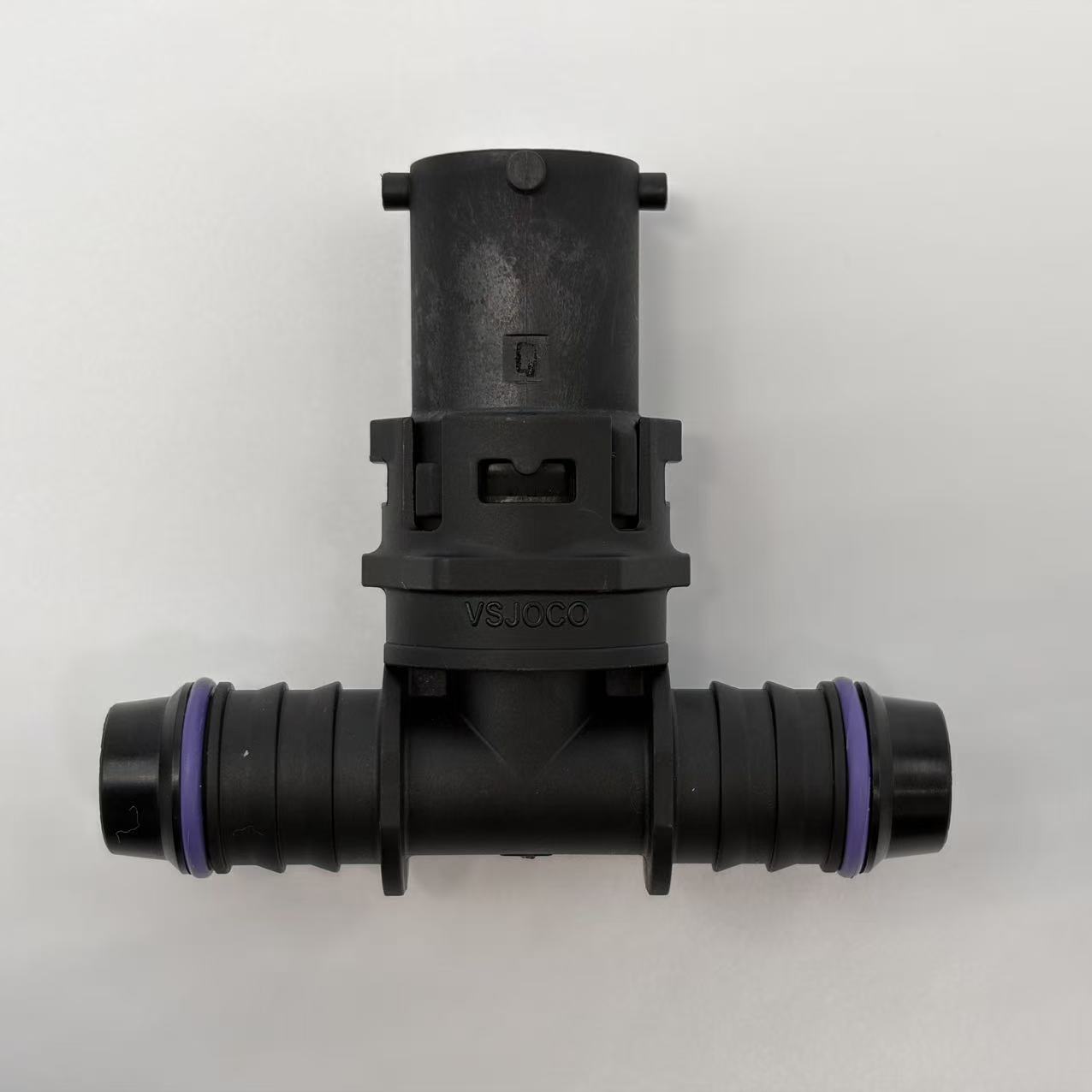
Pneumatic systems rely heavily on speed and airtight precision. For performance success, an air line fitting must deliver fast assembly. It must resist continuous machinery vibration. It also needs to maintain a perfect seal under standard shop air pressures. These facility pressures typically range from 90 to 150 psi. PA66 excels under these exact conditions. It absorbs micro-vibrations better than rigid metal counterparts.
In real-world implementations, a PA66 push-in tube connector offers massive reliability for automated manufacturing. Robotics engineers love them due to their incredibly low mass. Lower mass means less kinetic wear on moving robotic arms. They also boast a remarkably high cycle life. You can plug and unplug hoses thousands of times before the internal grab ring wears out.
But failure risks still exist in compressed air setups. Rapid-cycling pneumatic systems sometimes suffer from adiabatic heating. As valves open and close rapidly, compressed air gets surprisingly hot. This localized heat can soften the gripping teeth. You must also watch out for UV degradation. If you route air lines outdoors, standard PA66 becomes brittle over time. Sunlight breaks down the polymer chains. Always source UV-stabilized black variants for exterior deployments to prevent sudden cracking.
Fluid transfer introduces entirely new physical dynamics compared to air. PA66 is naturally hygroscopic. It continuously absorbs moisture from its surrounding environment. When acting as a water line connector, this moisture intake slightly increases the component dimensions. It actually increases overall impact toughness. The plastic becomes less brittle. However, it marginally reduces its core tensile strength. You must account for this dimensional shift in tightly packed manifolds.
Temperature ceilings require strict attention from piping engineers. Standard PA66 faces severe limits in hot water applications. You must aggressively avoid using it in sustained boiling water. High-pressure steam environments are equally dangerous. These extreme conditions cause rapid hydrolytic degradation. The plastic essentially breaks down at a molecular level, losing all mechanical integrity.
For closed-loop coolant compatibility, PA66 performs beautifully. It handles standard ethylene glycol mixtures perfectly. Automotive manufacturers use it constantly for low-pressure heater hoses. Data-center cooling applications also rely heavily on it to route chilled fluids. You just need to ensure the system remains strictly within the manufacturer specified temperature band.
Here are the critical water system guidelines to remember:
Chilled Water (35°F - 60°F): Excellent compatibility; dimensional swelling remains minimal.
Ambient Water (60°F - 100°F): Safe for long-term use; maximum impact toughness achieved.
Hot Water (100°F - 160°F): Proceed cautiously; verify burst pressures against the P-T curve.
Boiling Water/Steam (212°F+): Do not use; structural failure via hydrolysis is imminent.
Many engineers initially question plastic components in petrochemical settings. The facts speak clearly in favor of nylon. PA66 inherently possesses excellent chemical resistance. It easily handles aliphatic hydrocarbons, standard motor oils, and transmission fluids. Thick greases do not break down the resin structure either.
However, the real weak point lies deep inside the component. An oil-resistant fitting is only as good as its elastomer seal. The rubber O-ring dictates overall failure or success.
NBR (Nitrile): This serves as the industry standard for general oil and ambient pneumatics. Unfortunately, it degrades quickly at high temperatures. It will swell and crack if exposed to specialized synthetic fluids.
FKM (Viton): You absolutely require this material for high-temperature synthetic oils. It easily resists aggressive oil additives. It costs slightly more but prevents catastrophic fluid leaks.
Low-pressure constraints also apply heavily here. Hydraulic forums frequently debate plastic fittings. Let us clarify this limitation permanently. PA66 strictly belongs in low-to-medium pressure fluid return lines. You can use it safely for slow lubrication drips. Never deploy PA66 for high-pressure hydraulic power transmission. Hydraulic rams often spike above 3,000 psi. The burst risk remains far too high for any thermoplastic connector. Stick to metal for primary hydraulic power lines.
Selecting the right fluid component requires a highly systematic approach. Size and standardization rule the entire process. You must map out outer diameter (OD) tubing metrics exactly. The tubing must perfectly match the connector collar. Mixing Metric and Imperial sizes inevitably causes hidden micro-leaks. A 6mm tube will not seal safely in a 1/4-inch port, even if it feels snug initially.
Next, evaluate valved versus non-spill fluid traits. Sometimes you need a valved internal mechanism. These dry-break designs prevent hazardous fluid leaks during disconnection. They protect factory workers and keep floors clean. If you disconnect lines frequently, specify a valved model. Conversely, straight-through designs offer maximum flow rate. They contain no internal springs or valves. Use them when occasional fluid drips pose no danger and you need maximum volume.
Finally, verify compliance and certifications carefully. Different global industries demand specific standard compliance.
FDA or NSF certifications tightly govern potable drinking water safety.
RoHS compliance dominates global electronics and server data-center cooling.
ISO standards dictate predictable sizing, tolerance, and threading protocols.
Confirming these certifications upfront prevents costly redesigns down the road. Never assume a general-purpose fitting meets strict medical or food-grade requirements.
Transitioning to engineered plastics dramatically improves system efficiency and lowers overall procurement costs. PA66 proves itself highly capable across air, water, and oil. However, achieving long-term reliability demands careful component selection. Keep these actionable steps in mind as you finalize your designs:
Audit maximum system temperatures: Always consult the manufacturer P-T curve. Ensure pressure ratings remain safe at peak heat levels.
Match the elastomer to the fluid: Specify FKM O-rings for synthetic oils and high temperatures. Reserve standard NBR for basic pneumatic or cold-oil applications.
Respect the low-pressure boundary: Confine PA66 usage strictly to low-to-medium pressure lubrication, return, or cooling lines. Avoid high-power hydraulics completely.
Request comprehensive data sheets: Demand precise burst-pressure and material compatibility charts from your manufacturing partners. Do this before finalizing any bulk transition from metal.
A: Maximum pressure varies heavily by manufacturer and specific tube size. It typically peaks around 150 to 250 psi at ambient room temperatures. However, this rating drops significantly at elevated temperatures. Always refer to the manufacturer’s specific pressure-temperature (P-T) curve before finalizing your design.
A: It depends entirely on the water temperature. Cold or warm water remains completely safe. It causes only slight moisture absorption and minor dimensional swelling. Sustained hot water or steam environments, however, cause severe hydrolysis. This chemical reaction leads directly to mechanical breakdown and eventual component failure.
A: While PA66 naturally resists many hydrocarbons, fuel lines demand strict regulatory approvals. You must use specific FKM seals to prevent dangerous leaks. Always verify direct OEM compliance and safety certifications before using any plastic connector for highly volatile or flammable fuels.
A: The PA66 outer housing rarely fails first. The most common failure mode involves an incompatible internal O-ring. A standard NBR seal will quickly swell, crack, or degrade when exposed to hot synthetic oils. Upgrading to an FKM (Viton) seal usually resolves this leakage issue entirely.


